U of S researchers celebrate $10 million in NSERC funding
Fifty-seven U of S scientists and students were celebrated at an event with the Honourable Ralph Goodale
Research in environmental sciences was highlighted today as the Honourable Ralph Goodale, Canada’s Minister of Public Safety and Emergency Preparedness, joined officials at the University of Saskatchewan (U of S) in celebrating the success of its scientists funded through the Natural Sciences and Engineering Research Council of Canada (NSERC).
Fifty-seven U of S scientists and students will receive $10,481,408 from NSERC’s 2016 competition for the discovery research programs. The programs, which include funds for scholarships, fellowships, research supplements and equipment grants, support researchers and students who are furthering our understanding of the world and how it works.
“Investments in science and innovation drive greater productivity and competitiveness, and lead to a more prosperous future. With these investments in natural sciences and engineering brainpower, the government is demonstrating our commitment to research excellence in Saskatchewan,” said Goodale, on behalf of the Honourable Kirsty Duncan, Minister of Science.
“Our federal government’s ongoing support of research and innovation through NSERC continues to pay dividends for Canadians, finding solutions for pressing issues facing our province and country,” said U of S President Peter Stoicheff. “Our researchers’ consistent success in attracting national funding speaks to both the quality of their work and its relevance to our country and our world.”
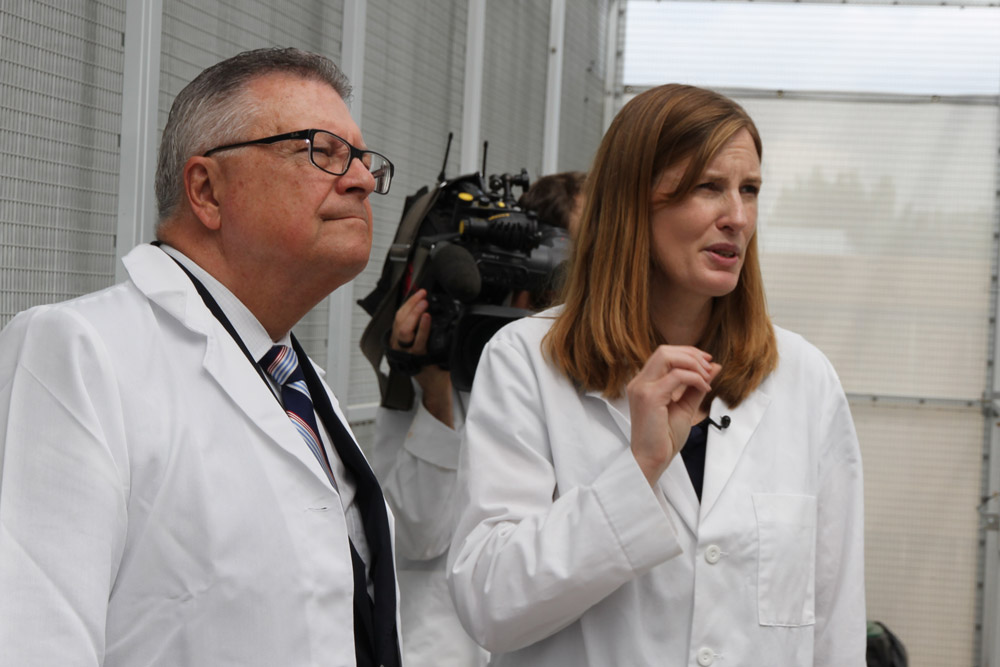
Today’s announcement was made at the U of S Western College of Veterinary Medicine and featured the work of wildlife ecotoxicologist Christy Morrissey, who secured a grant from all three NSERC funds, totaling $391,500. Morrissey, an associate professor of biology, specializes in the effects of pesticides and petroleum-derived pollution on songbirds, some populations of which have been cut in half in the last 50 years.
“As a society, we must balance the needs and demands of our own activities such as energy and agriculture with the health of our environment and the natural systems that sustain us,” Morrissey said. “With this latest support for our work, we hope to create the knowledge we need to conserve species, both for their intrinsic value as well as their real economic value to Canadians.”
Morrissey also led a tour through the new Facility for Applied Avian Research (FAAR), of which she is director. Her U of S co-investigators include prominent environmental toxicologist and Canada Research Chair John Giesy as well as veteran wildlife veterinarian and researcher Karen Machin.
FAAR, which started operating in May, is one of only two such facilities in Canada and the only one in Western Canada. The facility is designed to mimic various environmental conditions that allow for advanced research in ecotoxicology and bird health, including questions about the effects of pollutants on birds’ ability to put on weight and navigate. This is crucial for migrating species who must bulk up before the long flight to Central and South America, and where ending up in the wrong place is likely fatal.
Twenty-two U of S graduate students also were successful in securing over $885,000 in NSERC scholarships for projects that include the effects of oilsands waste and agricultural practices on soils and water, the structure of the human genome, fusion energy, and subatomic physics. Other projects will consider how to design power grids to better incorporate greater levels of renewable energy such as wind power, and how to design catalysts to produce biodiesel from low-quality, non-food vegetable oils.
The projects are part of more than $465 million for more than 4,000 grants awarded across the country announced by Federal Minister of Science Kirsty Duncan this summer. A full listing of the grant recipients is available at the NSERC website.
Related Articles
Farmers applaud restricted return of strychnine, experts warn of non-target poisonings
Agricultural groups and farmers are applauding the move, but USask biology professor Dr. Christy Morrissey (PhD) argues the chemical isn't safe
Groundbreaking computer positions University of Saskatchewan as key player in global quantum research
New technology will enhance cutting-edge research in human health research, energy and agriculture