International USask student finds connection through science
USask graduand credits USask, Canadian Light Source with providing unique opportunities
By Kristen McEwen
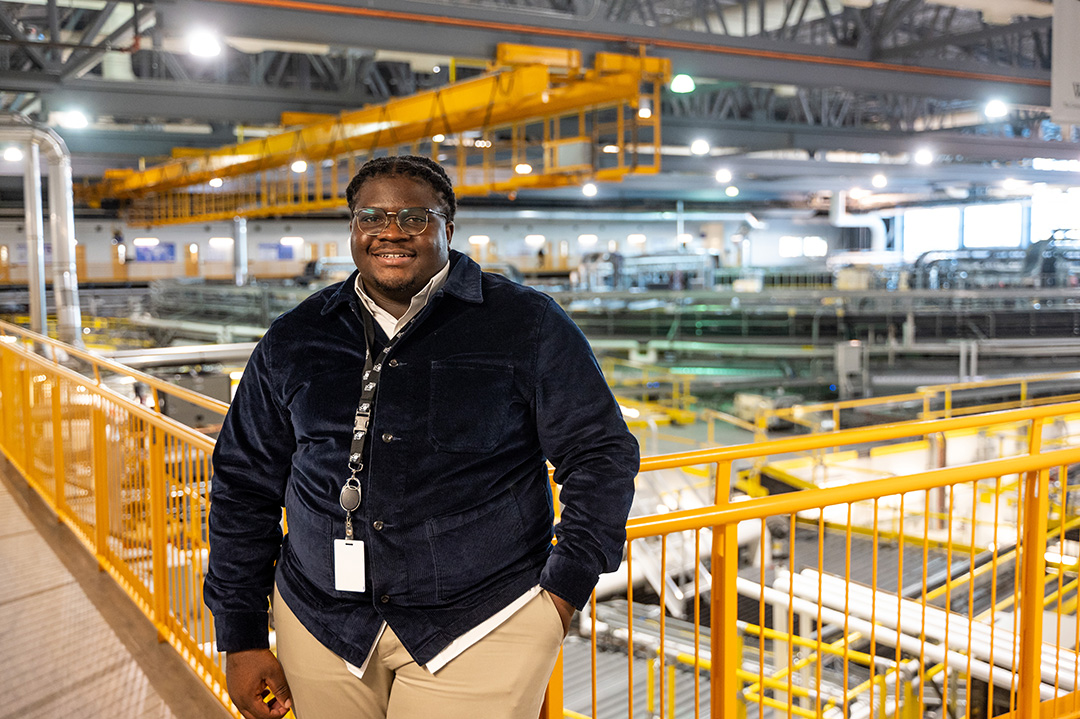
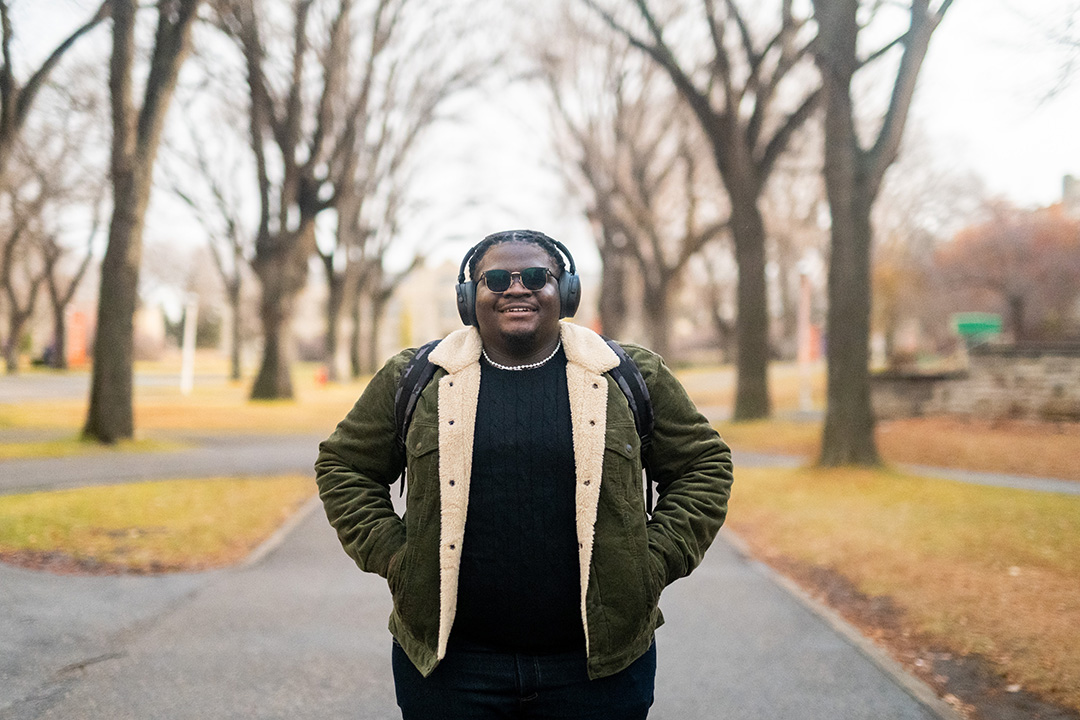
Osebi Daudu’s interest in astrophysics began when he was a child.
“Looking up at the night sky, the stars and the universe, (I had) that typical curiosity of what is out there and understanding it,” Daudu said. “I wanted to follow that up with a university degree.”
Daudu will be graduating with his Bachelor of Science (Honours) degree in Physics with a specialization in Materials Science, with a Certificate in Astronomy and a minor in Mathematics. He will be crossing the stage at this year’s University of Saskatchewan (USask) Spring Convocation on June 2.
An international student who grew up in northern Nigeria, Daudu had a strong “knack for innovation and science.”
From astrophysics to mechanical and electrical engineering, Daudu knew that a physics degree would open doors for career paths.
“Physics basically puts me in a position where I could try to be in several facets of science,” he said.
When it came to decide where to go for university, he remembered a place called Saskatchewan that his mother had visited many years prior.
“(USask) had obviously become an option my mom had told me about,” he said. “I found that USask in the history of science is actually downplayed. USask has played a very pivotal role in the evolution of science.”
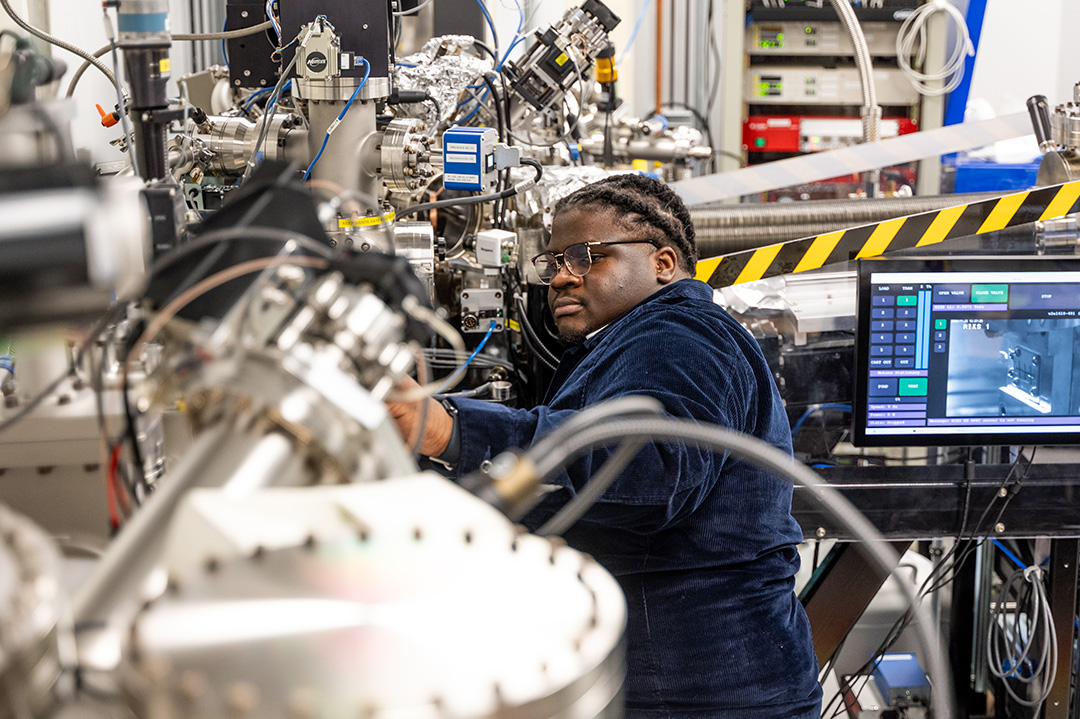
The Canadian Light Source—Canada’s only synchrotron—was also an appealing part of USask for an aspiring physics student.
After arriving at USask in 2022, Daudu was part of USask’s student-led RADSAT-SK Team. The student-led team built a satellite that was launched to the International Space Station in 2023. The team built a cube satellite that is believed to be the first made-in-Saskatchewan satellite that was sent into space. Students spent five years working on the project.
“I think it changed my perspective for the rest of my undergraduate career,” Daudu said. “It felt like I was doing something very special—I was part of something big. I wanted to keep being part of something big at every stage after that point, because you’ve done something very pivotal and you understand what it means to be part of something big, to be important.”
Daudu decided to specialize in materials science for his honours degree. He had the opportunity to spend two years researching novel materials using density functional theory and synchrotron techniques at the Canadian Light Source as an undergraduate student.
He was part of Dr. Alexander Moewes (PhD)’s Beamteam Research Group. Moewes is a professor in the Department of Physics and Engineering Physics as well as the Canada Research Chair in Materials Science with Synchrotron Radiation.
“(The synchrotron is) something you’d get to experience in a much later stage in your (career),” he said. “So these advantages were things that were very important highlights for me. It gives me an edge that I’d have for the rest of my life, things I would never forget.”
Daudu will also be graduating from USask with an astronomy certificate.
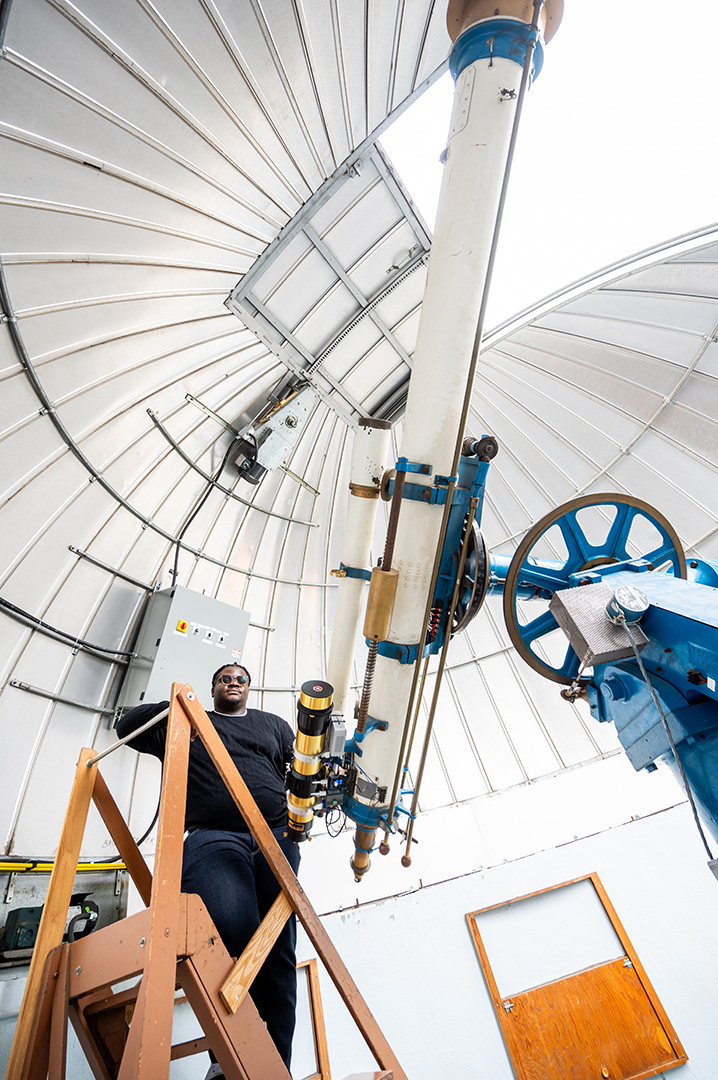
“Astronomy is a huge part of USask, the community,” he said. “For example, we have the Observatory, and I think that’s the biggest bridge between the university and the community because it’s one thing (everyone can) easily understand.”
A member of the public, and a student and a researcher can all use the same telescope to look at the night sky, he said.
“It reminds me of why we do science and how it’s important to people,” he said. “Having to discuss with kids of every age, older people, middle-aged people, and you have to explain things in very different manners because they all have questions that are different.”
Daudu volunteered at the Observatory for three years as a guide. “It was a nice way to communicate with the rest of Saskatoon.”
“It’s very nice to be able to stay grounded and communicate with everyone and be able to explain science as not something that’s complicated and dystopian,” he said. “It’s something that’s all part of us, and we should all embrace and enjoy. That was my favourite part about the Observatory.”
He felt fortunate to receive financial support through scholarships from the College of Arts and Science, and the Department of Physics and Engineering Physics. He was awarded the Ruth and Eber Pollard Scholarship in Physics and the International Student Award in STEM for a Better World.
“That’s exactly what got me to finish this degree, it was the support that I got from the university.”
Daudu tried to balance his studies with volunteer work. He was president of the Physics and Engineering Physics Students' Society in 2025. He also volunteered to be part of the Canadian Association of Physicists (CAP) Student Advisory Council as a Black Student Representative since 2023.
“I represented Black students across the country,” he said. “Doing all of these things, it was a bit hard to maintain that balance but I could not live my life any other way because I thought it was imperative for the academic side to be present, my research to be present and for a community-engaged perspective for myself. I found it important that I gave to the community as much as I got from it.”
Daudu is currently working with Brisk Innovations Inc. in Saskatoon, on helmet technologies aimed at reducing concussion risk in sports.
His advice for students new to USask is to pursue things that inspire them, and to be the change they want to see in the world.
"If I could go back in time, I would do it again because the number of people who get inspired to do things you did—to try to be in the student community and be a president and change things. Or find a problem—and not just speak about it—but decide to make change.
“It’s part of being what the world needs, that’s really what it is.”
Related Articles
Top humanities graduate finds her passion, community at USask
Emily Zbaraschuk’s academic achievements recognized with multiple convocation awards
USask receives NSERC award for Science Ambassador Program
Zoe Slusar wants to inspire young people about the possibilities of science