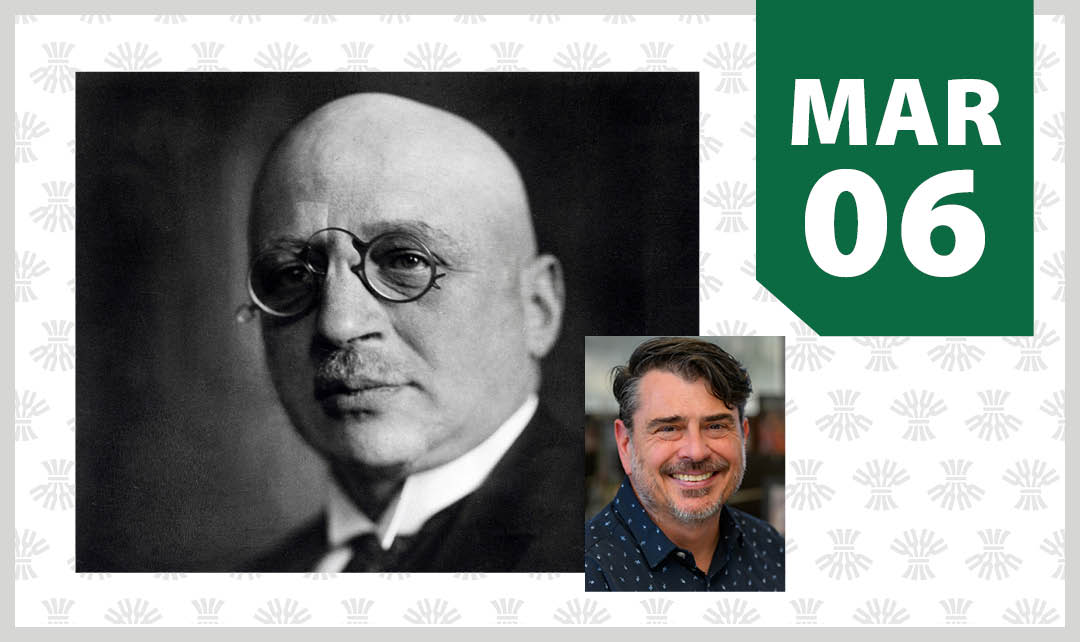
The Lives of Fritz Haber and of International Law: Entwined Tales of Tragedy and Irony
This lecture will be presented by Mark A. Drumbl, Class of 1975 Alumni Professor at Washington and Lee University
Date: Friday, March 6
Time: 1-2:30 pm
Location: Arts 272
This event is part of the Political Studies Speaker Series.
About this event
This Political Studies Speaker Series event is presented by Mark A. Drumbl, Class of 1975 Alumni Professor at Washington and Lee University, where he also serves as Director of the university's Transnational Law Institute.
This talk recounts the life of international law through the story of a single individual. This is the narrative of biographical international law. The subject-equally protagonist and antagonist-of this article is Fritz Haber, a German-Jewish scientist born in 1868.
Devoted to the Kaiser, Haber was declared a war criminal by the Allies following World War I for having been 'the father' of chemical warfare. Haber argued that chemical weapons were more humane than conventional weapons.
While under this shadow, Haber also won the Nobel Prize for chemistry in 1920 for his pioneering work with ammonia fertilizer: Haber's method of synthesizing fertilizer has wildly expanded global food production to this date.
In the 1930s, Haber was persecuted for his Jewish heritage by the very nation he had zealously served. Haber's research ultimately constituted one of the bases for the development of Zyklon-B gas, which became deployed against humans rather than Haber's initial conception as an insecticide. Haber died, a tormented and broken man, in Basel, Switzerland, in 1934.
In addition to being, variously, hero and villain, Haber was also both oppressor and oppressed. Through an exploration of Haber's life, this article unfurls key aspects and unresolved corners of international criminal law, including the ethical responsibility of scientists in their research; the intersection of scientism, militarism, and nationalism; humanitarian concern in the deaths of soldiers; the legal status of chemical weapons in contradistinction to conventional and nuclear weapons; the historiographical place of World War I in the development of international criminal law; and the sheer complexity of identity.
Upcoming Events
Threads of Time: An Asian Heritage Month Exhibition
May 4-22, 2026
Xiao Han curates this exhibition bringing together six Saskatoon-based emerging artists connected to USask
Strayhorn: The Quiet Revolutionary
May 23, 2026
USask music professor Dean McNeill is artistic director of the SJO