Creating ‘Ethical Spaces in Treaty Places’
Elder Willie Ermine brings teachings about creating safe, ethical co-learning spaces to USask, City of Saskatoon
By Kristen McEwen
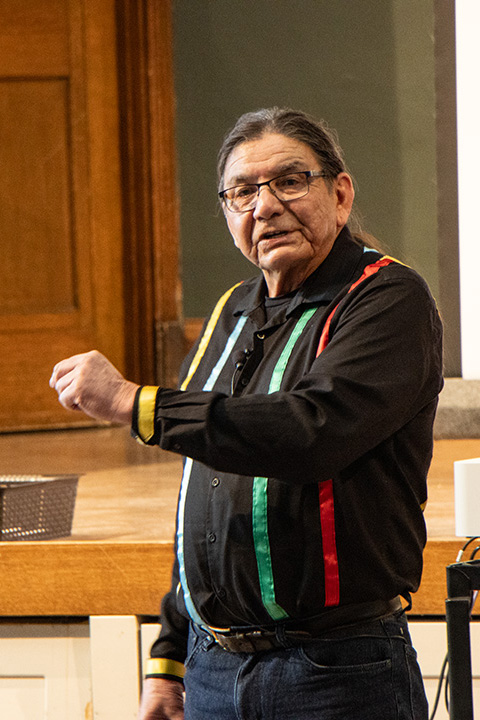
Elder Willie Ermine knows that people from different cultures can come together to co-create ethically safe spaces to ask questions and learn.
“(Ethical Spaces are) about understanding each other, because much of our dialogue happens at the prescribed level — our workspaces prescribe what we can say,” Ermine said. “For example, a policeman has to talk the policeman language, or an administrator has to talk the administrator language, a priest has to talk the religious language.”
Ermine is an Elder and ceremonial healer from Sturgeon Lake First Nation, as well as a retired Emeritus Professor at the First Nations University of Canada.
“We never really engage or make connections with the person if we’re speaking from those prescriptive languages – we simply just can’t understand each other,” he added.
He said that if people can have discussions in spaces without those prescribed roles and languages, then substantial relationships and transformative discussions can happen.
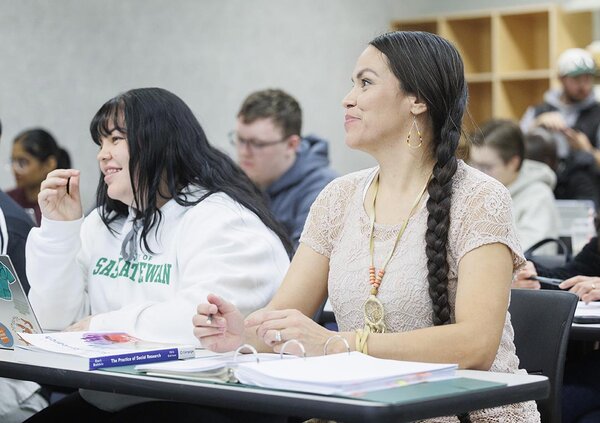
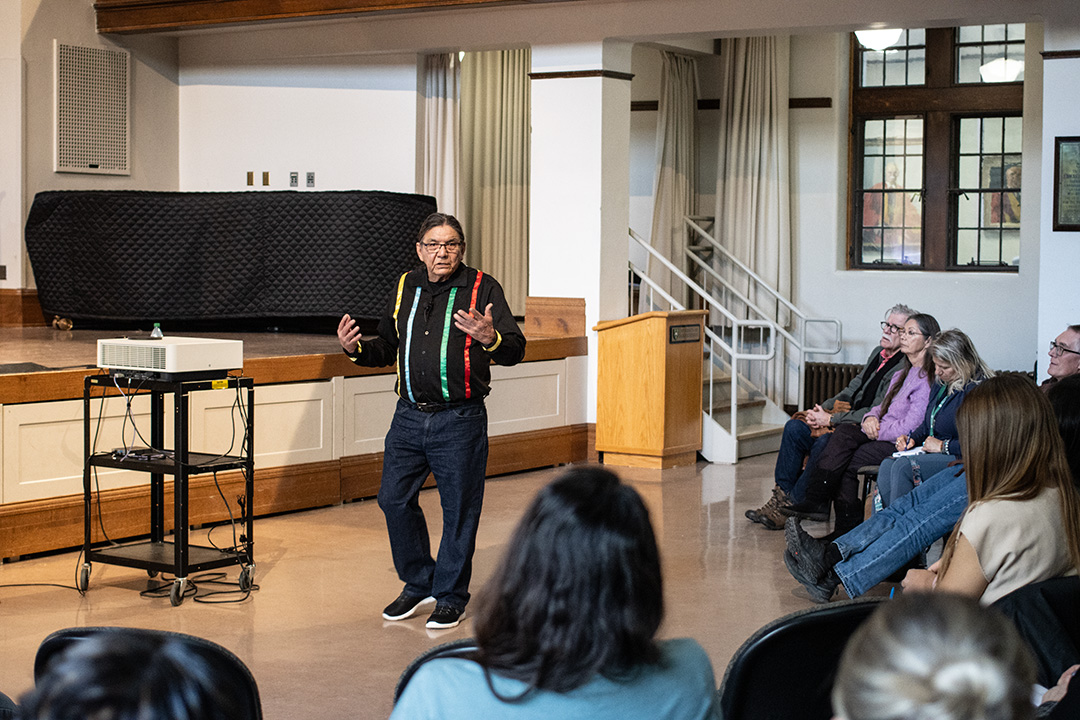
Ermine was invited to Convocation Hall at the University of Saskatchewan (USask) to share teachings during two workshops, “Ethical Spaces in Treaty Places.” Nearly 90 people attended, including USask faculty, staff, students and employees from the City of Saskatoon on Jan. 14 and Jan. 15.
The workshops were supported by the City of Saskatoon, the Trish Monture Centre, the Indigenous Student Achievement Pathways (ISAP) learning community, and the College of Arts and Science Equity, Diversity and Inclusion Fund, administered by the Vice-Dean Faculty Relations.
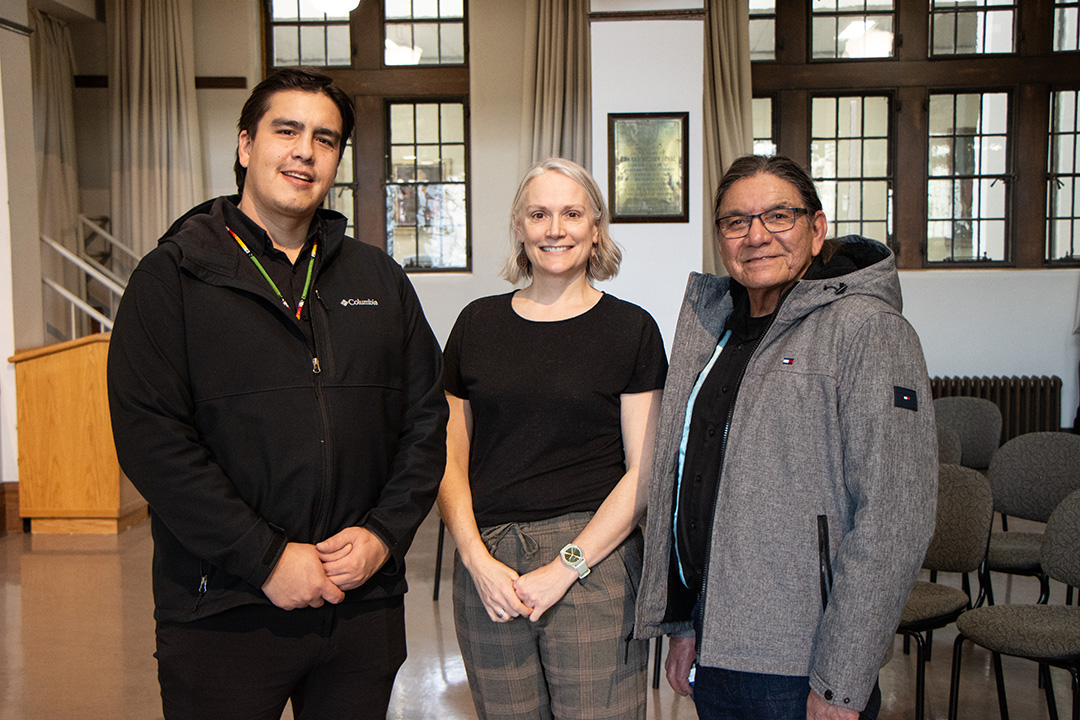
ISAP team lead Dr. Sandy Bonny (PhD) worked with past ISAP student and peer mentor Bryce Naytowhow to develop the two sessions.
“I knew about Willie’s academic work, and Bryce knew about his cultural role as an Elder—we were both excited about bringing (Willie) to facilitate learning among our communities of practice,” Bonny said.
Naytowhow, is currently a third-year psychology student and Oskâpêwis— Neyhiyaw for ceremonial helper—from Montreal Lake Cree Nation, where he also knows Ermine from ceremony. He is currently working with the City of Saskatoon as a cultural resource specialist and was looking for opportunities to nurture cross-cultural capacity among City of Saskatoon staff. Bonny and Naytowhow invited Ermine to develop the sessions as a shared professional development event, anticipating that bringing USask and City of Saskatoon communities of practice together would foster rich co-learning
In his article published in 2007 entitled, “The Ethical Space of Engagement,” Ermine writes that an “’ethical space’ is formed when two societies, with disparate worldviews, are posted to engage each other.”
“It is the thought about diverse societies and the space between them that contributes to the development of a framework for dialogue between human communities.”
This “space” allows groups to form a collaborative spirit between Indigenous peoples and Western institutions, Ermine writes.
As part of his workshops, Ermine spoke about Indigenous ways of knowing, philosophical and spiritual teachings.
“One of our biggest obligations (as people) and our highest goals are to achieve higher states of being — to get to higher levels of humanity,” Ermine said.
“That’s the whole purpose of it, sort of a bigger philosophical purpose of this is really, how do we work on improving our humanity so we can reach higher levels, as we were intended to do,” he added.
When asked about her experience during the session, Bonny replied that attending the workshops was very different from reading Ermine’s academic papers.
“I had read about Willie’s conceptualization of Ethical Space, and appreciated that differences of experience, worldview and perspective/lens are real, but also that these differences do not have to be a barrier to the engagement of Indigenous and non-Indigenous people in ethical and mutually generous ways,” Bonny said.
“Pulling us into activities, storytelling and language teaching, the workshops Willie facilitated created a living space to reflect on how we carry internal resources — personal, cultural and ancestral— into encounters in our professional and personal worlds. I think he inspired a diversity of connection points for participants—he offered many invitations to draw and take away personal meaning,” she added.
With each session, Ermine intends to plant a seed within each participant, to take what they’ve learned with them and share with others.
“Our old people say everything is spiritual — that includes our language, our words, our sounds, knowledge. Everything is spiritual — it has a consciousness, a spirit to it, an awareness and a responsiveness,” he said.
“it’s not up to me to decide how they (the words) must work, but how the bigger world will decide how they must work. Our purpose is to let go of that knowledge and not hoard it, not keep it.”
Related Articles
USask students receive Lieutenant Governor Scholarship awards
Mehdi Khalaj, a PhD student in Computer Science (Quantum Bioinformatics), is a recipient of a 2026-27 Saskatchewan Lieutenant Governor Scholarship
Arts and Science faculty, students recognized for their outstanding, impactful RSAW contributions
College of Arts Arts and Science introduces Expression Prize to broaden how RSAW contributions are recognized