Faculty Publication 2016 - present
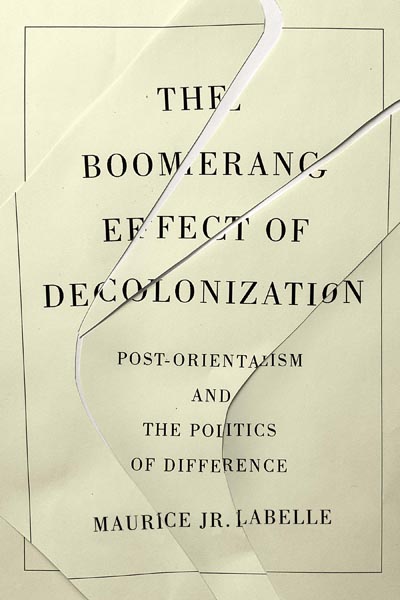 The Boomerang Effect of Decolonization: Post-Orientalism and the Politics of Difference. McGill-Queen's University Press, 2023.
From the Publisher:
The 1978 publication of Edward Said's Orientalism unsettled the world. Over two decades earlier Aimé Césaire had famously spoken of the boomerang effect of colonization, which dehumanized both the colonizer and the colonized. Over time, Said and his 1978 book took Césaire’s anti-imperial critique one step further by enabling the boomerang effect of decolonization.
Inspired by that intellectual trajectory, The Boomerang Effect of Decolonization redefines post-Orientalism in a relational and integrative way. This volume draws on the reception and critique of Said’s ideas as well as his own attempts to appropriate the boomerang’s recursive nature and empower decolonial processes that aimed to transform everyone, regardless of differences both imagined and real, for the betterment of all. Reflecting upon Orientalism, its legacies, and the myriad conversations it has generated, scholars from various disciplines examine acts of anti-racism and liberation through the lens of critical race theory. Covering topics including Said’s anti-Orientalist world, Métis/Michif consciousness, writing by the French scholar Jacques Berque, the politics of allyship in the Israeli-Palestinian conflict, and the convergence between healthcare and settler-colonialism in Northwestern Ontario, contributors explore the different paths critiques of imperial cultures and their politics of difference have travelled in Canada and abroad. Said’s Orientalism reoriented both decolonization itself and his readers’ imaginations. By redefining post-Orientalism as a relational and inclusive mode of liberation, this volume offers tools to think about difference differently, centring its anti-racist framework on the relationship between misrepresented people and their rewritten histories.
Contributors include Yasmeen Abu-Laban (Alberta), Rachad Antonius (UQAM), Sung Eun Choi (Bentley), Mary-Ellen Kelm (Simon Fraser), Allyson Stevenson (Saskatchewan), Mira Sucharov (Carleton), and Lorenzo Veracini (Swinborne).
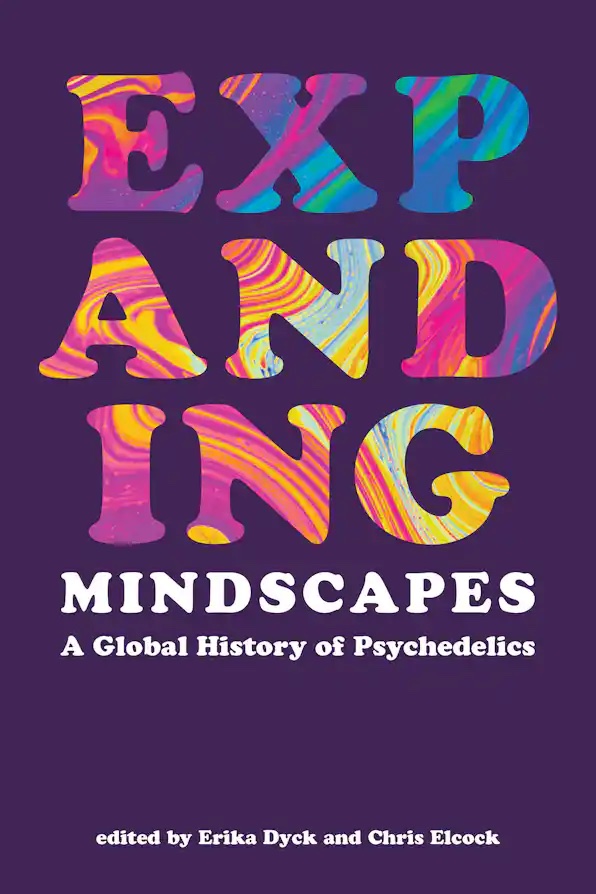 Expanding Mindscapes: A Global History of Psychedelics. MIT Press, 2023.
From the Publisher
The first collection of its kind to explore the diverse and global history of psychedelics as they appealed to several generations of researchers and thinkers.
Expanding Mindscapes offers a fascinatingly fluid and diverse history of psychedelics that stretches around the globe. While much of the literature to date has focused on the history of these drugs in the United States and Canada, editors Erika Dyck and Chris Elcock deliberately move away from these places in this collection to reveal a longer and more global history of psychedelics, which chronicles their discovery, use, and cultural impact in the twentieth century.
The authors in this collection explore everything from LSD psychotherapy in communist Czechoslovakia to the first applications of LSD-25 in South America to the intersection of modernism and ayahuasca in China. Along the way, they also consider how psychedelic experiments generated their own cultural expressions, where the specter of the United States may have loomed large and where colonial empires exerted influence on the local reception of psychedelics in botanical and pharmaceutical pursuits.
Breaking new ground by adopting perspectives that are currently lacking in the historiography of psychedelics, this collection adds to the burgeoning field by offering important discussions on underexplored topics such as gender, agriculture, parapsychology, anarchism, and technological innovations.
 Everyday Magicians in Tudor England. University Park: Penn State University Press, 2022.
From the Publisher:
Most of the women and men who practiced magic in Tudor England were not hanged or burned as witches, despite being active members of their communities. These everyday magicians responded to common human problems such as the vagaries of money, love, property, and influence, and they were essential to the smooth functioning of English society. This illuminating book tells their stories through the legal texts in which they are named and the magic books that record their practices. In legal terms, their magic fell into the category of sin or petty crime, the sort that appeared in the lower courts and most often in church courts. Despite their relatively lowly status, scripts for the sorts of magic they practiced were recorded in contemporary manuscripts. Juxtaposing and contextualizing the legal and magic manuscript records creates an unusually rich field to explore the social aspects of magic practice.
Expertly constructed for both classroom use and independent study, this book presents in modern English the legal documents and magic texts relevant to ordinary forms of magic practiced in Tudor England. These are accompanied by scholarly introductions with original perspectives on the subjects. Topics covered include: the London cunning man Robert Allen; magic to identify thieves; love magic; magic for hunting, fishing and gambling, and magic for healing and protection.
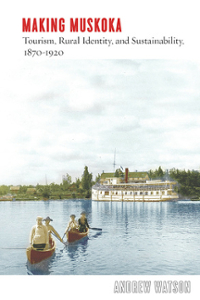 Making Muskoka Tourism, Rural Identity, and Sustainability, 1870–1920. Vancouver: University of British Columbia, 2022.
From the Publisher:
Making Muskoka traces the evolution of the region from 1870 to 1920. Over this period, this rocky section of Ontario underwent a profound transition from Indigenous homelands to a settler community and a part-time playground for nature tourists and wealthy cottagers. But what were the consequences for those who lived there year-round?
As the late nineteenth century turned into the early twentieth, settler colonialism upended Anishinaabe and Haudenosaunee communities through homesteading, steamboat navigation, commercial logging, and industrial leather tanning. The region was unsuited to farming, however, and within the first generation of resettlement, tourism became an integral feature of life. Andrew Watson considers the impact of this development on rural identity, tensions between large- and household-scale logging operations, and the dramatic effects of consumer culture and the global shift toward fossil fuels on settlers’ ability to control the tourism economy after 1900.
Making Muskoka uncovers the connections between lived experience and rural identity in communities shaped by tourism at a time when sustainable opportunities for a sedentary life were few on the Canadian Shield.
Scholars and students of environmental history, Canadian history, and historical geography will want to add this book to their libraries, as will permanent and part-time Muskoka residents.
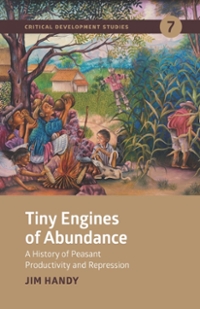 Tiny Engines of Abundance: A History Peasant Productivity and Repression. Winnipeg/Rugby UK: Fernwood Press/Practical Action Publishing, 2022.
From the Publisher:
This book provides a historical and comparative perspective of peasant productivity using case studies portraying the extraordinary efficiency with which English cottagers, Jamaican ex-slaves, Guatemalan Mayan campesinos, Nigerian hill farmers and Kerala hut dwellers obtained bountiful and diversified harvests from small parcels of land, provisioning for their families and often local markets. These stories provide us with pictures of carefully limited needs, of sustainable livelihoods and of resilient self-reliance attacked relentlessly and mercilessly in the name of capital, progress, development, modernity and/or the state. For two hundred years we have been told that the hundreds of thousands, or millions, or billions of hungry mouths require that peasants be dispossessed to allow more industrious farmers to feed them. This book helps make it clear how wrong we have been. Handy’s approach is original, and the book will engage people interested in the history of the peasantry, rural development, and the quest for food sovereignty.
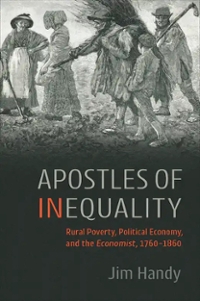 Apostles of Inequality: Rural Poverty, Political Economy and the Economist, 1760-1860. Toronto: University of Toronto Press, 2022.
From the Publisher:
Between 1760 and 1860, the English countryside was subject to constant attempts at agricultural improvement. Most often these meant depriving cottagers and rural workers of access to land they could cultivate, despite evidence that they were the most productive farmers in a country constantly short of food.
Drawing from a wide range of contemporary sources, Apostles of Inequality argues that such attempts, driven by a flawed faith in the wonders of capital, did little to increase agricultural productivity and instead led to a century of increasing impoverishment in rural England. Jim Handy rejects the assertions about the benefits that accompanied the transition to "improved" agriculture and details the abundant evidence for the efficiency of smallholder, peasant agriculture. He traces the development of both economic theory and government policy through the work of agricultural improver Arthur Young (1741–1820), government advisor Nassau William Senior (1790–1864), and the editors and writers of the Economist, as well as Adam Smith and Thomas Robert Malthus.
Apostles of Inequality demonstrates how a fascination with capital – promoted by political economy and farmers’ desires to have a labour force completely dependent on wage labour – fostered widespread destitution in rural England for over a century.
 The Acid Room: The Psychedelic Trials and Tribulations of Hollywood Hospital. Vancouver: Anvil Press, 2022.
From the Publisher:
From the street, New Westminster’s Hollywood Hospital didn’t look like much – just a rambling white mansion, mostly obscured behind the holly trees from which it took its name.
But, between 1957 and 1968, it was the site of more than 6000 supervised acid trips, as part of the burgeoning (and controversial) field of psychedelic psychiatry. Under the care of Medical Director J Ross MacLean, and ex-spy/researcher Al “Captain Trips” Hubbard, it became a mecca for alcoholics, anxiety patients, and unhappy couples (as well as celebrities like Andy Williams), its unorthodox methods boasting a success rate of nearly 80%. But the same media attention that brought the hospital to prominence also assured its downfall, as prohibition forces drove their work underground for more than fifty years.
Written by 49.2 regular Jesse Donaldson and academic historian Erika Dyck, The Acid Room takes readers into the hospital’s inner sanctum, charting its meteoric rise and fall as it opened up brave new worlds in medicine, and put Canada at the forefront of a movement that is only now being fully explored.
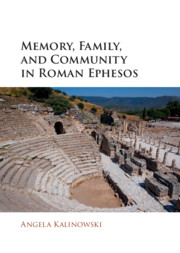
Memory, Family, and Community in Roman Ephesos. Cambridge University Press, 2021.
From the Publisher:
"This is the first book to analyse urban social relations in the eastern Roman Empire through the perspective of one elite family. From the late first to the mid-third century CE, the Vedii and their descendants were magistrates, priests and priestesses of local and imperial cults, and presided over Ephesos' many religious festivals. They were also public benefactors, paying for the construction of public buildings for the pleasure of fellow citizens. This study examines the material evidence of their activities - the buildings with their epigraphic and decorative programs – to show how members of the family created monuments to enhance their own and their family's prestige. It also discusses the inscriptions of the honorific statue monuments raised by the city and its sub-groups for the family in return for their benefactions, arguing that these reflect the community's values and interests as much as they commemorate the benefactors and their families."
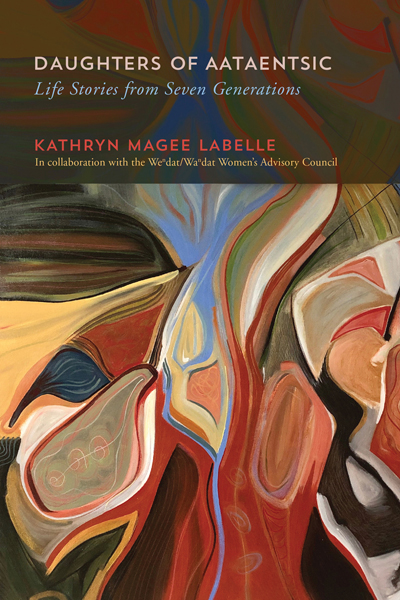 Daughter of Aataentsic: Life Stories from Seven Generations. McGill-Queen's University Press, 2021.
Une histoire des ouendats au dix-septième siècle. Québec City: Presse Université Laval (pocket book version of Le Pari de La Dispersion), 2020.
From the Publisher:
"Daughters of Aataentsic highlights and connects the unique lives of seven Wendat/Wandat women whose legacies are still felt today. Spanning the continent and the colonial borders of New France, British North America, Canada, and the United States, this book shows how Wendat people and place came together in Ontario, Quebec, Michigan, Ohio, Kansas, and Oklahoma, and how generations of activism became intimately tied with notions of family, community, motherwork, and legacy from the seventeenth to the twenty-first century. The lives of the seven women tell a story of individual and community triumph despite difficulties and great loss.
Kathryn Magee Labelle aims to decolonize the historical discipline by researching with Indigenous people rather than researching on them. It is a collaborative effort, guided by an advisory council of eight Wendat/Wandat women, reflecting the needs and desires of community members. Daughters of Aataentsic challenges colonial interpretations by demonstrating the centrality of women, past and present, to Wendat/Wandat culture and history. Labelle draws from institutional archives and published works, as well as from oral histories and private collections.
Breaking new ground in both historical narratives and community-guided research in North America, Daughters of Aataentsic offers an alternative narrative by considering the ways in which individual Wendat/Wandat women resisted colonialism, preserved their culture, and acted as matriarchs."
Short Listed - Saskatchewan Book Award. Category: Jennifer Welsh Scholarly Award, 2022.
Short Listed – Saskatchewan Book Award. Category: Non-Fiction Award, 2022.
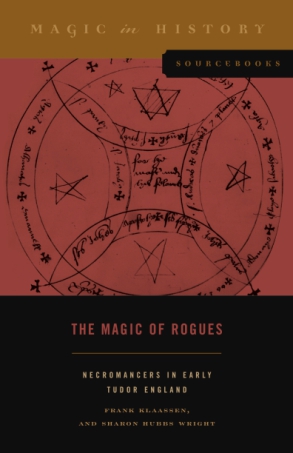 The Magic of Rogues: Necromancers in Early Tudor England. Penn State University Press, 2021.
From the Publisher:
"In 1510, nine men were tried in the Archbishop’s Court in York for attempting to find and extract a treasure on the moor near Mixindale through necromantic magic. Two decades later, William Neville and his magician were arrested by Thomas Cromwell for having engaged in a treasonous combination of magic practices and prophecy surrounding the death of William’s older brother, Lord Latimer, and the king.
In The Magic of Rogues, Frank Klaassen and Sharon Hubbs Wright present the legal documents about and open a window onto these fascinating investigations of magic practitioners in early Tudor England. Set side by side with sixteenth- and seventeenth-century texts that describe the sorts of magic those practitioners performed, these documents are translated, contextualized, and presented in language accessible to nonspecialist readers. Their analysis reveals how magicians and cunning folk operated in extended networks in which they exchanged knowledge, manuscripts, equipment, and even clients; foregrounds magicians’ encounters with authority in ways that separate them from traditional narratives about witchcraft and witch trials; and suggests that the regulation and punishment of magic in the Tudor period were comparatively and perhaps surprisingly gentle. Incorporating the study of both intellectual and legal sources, The Magic of Rogues presents a well-rounded picture of illicit learned magic in early Tudor England.
Engaging and accessible, this book will appeal to anyone seeking to understand the intersection of medieval legal history, religion, magic, esotericism, and Tudor history."
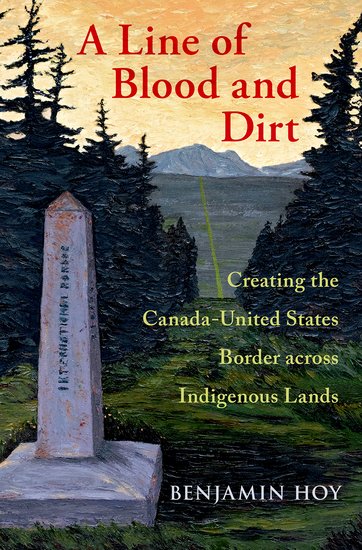 A Line of Blood and Dirt: Creating the Canada-United States Border across Indigenous Lands. Oxford University Press, 2021.
From the Publisher:
"Often described as the longest undefended border in the world, the Canada-US border was born in blood, conflict, and uncertainty.
At the end of the American Revolution, Britain and the United States imagined a future for each of their nations that stretched across a continent. They signed treaties with one another dividing lands neither country could map, much less control. A century and a half later, Canada and the United States had largely fulfilled those earlier ambitions. Both countries had built nations that stretched from the Atlantic to the Pacific and had made an expansive international border that restricted movement.
The vision that seemed so clear in the minds of diplomats and politicians never behaved as such on the ground. Both countries built their border across Indigenous lands using hunger, violence, and coercion to displace existing communities and to disrupt their ideas of territory and belonging. The border's length undermined each nation's attempts at control. Unable to prevent movement at the border's physical location for over a century, Canada and the United States instead found ways to project fear across international lines They aimed to stop journeys before they even began."
Governor General’s History Award for Scholarly Research (also known as Best Scholarly Book in Canadian History Prize, Canadian Historical Association - CHA), 2022.
Best Book in Political History Prize (Canadian Historical Association - CHA), 2022.
The Albert Corey Prize in the History of Canada-American Relations (offered jointly by the American Historical Association and Canadian Historical Association), 2022.
 Challenging Choices: Canada's Population Control in the 1970s. McGill-Queen's University Press, 2020.
From the Publisher:
"Between the decriminalization of contraception in 1969 and the introduction of the Charter of Rights and Freedoms in 1982, a landmark decade in the struggle for women's rights, public discourse about birth control and family planning was transformed. At the same time, a transnational conversation about the "population bomb" that threatened global famine caused by overpopulation embraced birth control technologies for a different set of reasons, revisiting controversial ideas about eugenics, heredity, and degeneration.
In Challenging Choices Erika Dyck and Maureen Lux argue that reproductive politics in 1970s Canada were shaped by competing ideologies on global population control, poverty, personal autonomy, race, and gender. For some Canadians the 1970s did not bring about an era of reproductive liberty but instead reinforced traditional power dynamics and paternalistic structures of authority. Dyck and Lux present case studies of four groups of Canadians who were routinely excluded from progressive, reformist discourse: Indigenous women and their communities, those with intellectual and physical disabilities, teenage girls, and men. In different ways, each faced new levels of government regulation, scrutiny, or state intervention as they negotiated their reproductive health, rights, and responsibilities in the so-called era of sexual liberation.
While acknowledging the reproductive rights gains that were made in the 1970s, the authors argue that the legal changes affected Canadians differently depending on age, social position, gender, health status, and cultural background. Illustrating the many ways to plan a modern family, these case studies reveal how the relative merits of life and choice were pitted against each other to create a new moral landscape for evaluating classic questions about population control."
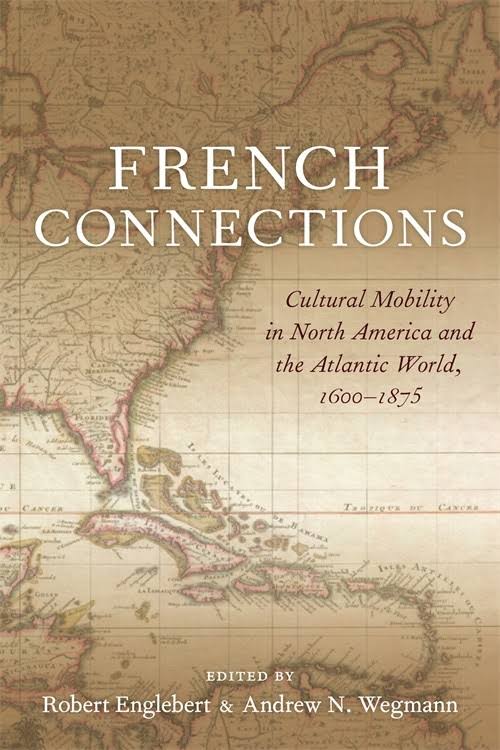 French Connections: Cultural Mobility in North America and the Atlantic World, 1600-1875. LSU Press, 2020.
From the Publisher:
"French Connections examines how the movement of people, ideas, and social practices contributed to the complex processes and negotiations involved in being and becoming French in North America and the Atlantic World between the years 1600 and 1875. Engaging a wide range of topics, from religious and diplomatic performance to labor migration, racialization, and both imagined and real conceptualizations of “Frenchness” and “Frenchification,” this volume argues that cultural mobility was fundamental to the development of French colonial societies and the collective identities they housed. Cases of cultural formation and dislocation in places as diverse as Quebec, the Illinois Country, Detroit, Haiti, Acadia, New England, and France itself demonstrate the broad variability of French cultural mobility that took place throughout this massive geographical space. Nevertheless, these communities shared the same cultural root in the midst of socially and politically fluid landscapes, where cultural mobility came to define, and indeed sustain, communal and individual identities in French North America and the Atlantic World.
Drawing on innovative new scholarship on Louisiana and New Orleans, the editors and contributors to French Connections look to refocus the conversation surrounding French colonial interconnectivity by thinking about mobility as a constitutive condition of culture; from this perspective, separate “spheres” of French colonial culture merge to reveal a broader, more cohesive cultural world. The comprehensive scope of this collection will attract scholars of French North America, early American history, Atlantic World history, Caribbean studies, Canadian studies, and frontier studies. With essays from established, award-winning scholars such as Brett Rushforth, Leslie Choquette, Jay Gitlin, and Christopher Hodson as well as from new, progressive thinkers such as Mairi Cowan, William Brown, Karen L. Marrero, and Robert D. Taber, French Connections promises to generate interest and value across an extensive and diverse range of concentrations."
Winner of the Wilson Institute for Canadian History Book Prize, 2021.
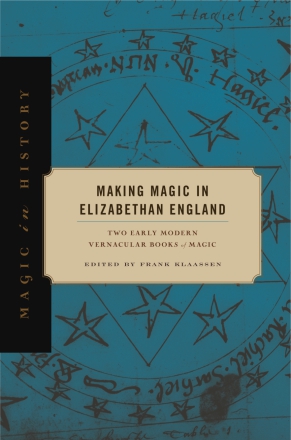 Making Magic in Elizabethan England: Two Early Modern Vernacular Books of Magic. Penn State University Press, 2019.
From the Publisher:
"This volume presents editions of two fascinating anonymous and untitled manuscripts of magic produced in Elizabethan England: the Antiphoner Notebook and the Boxgrove Manual. Frank Klaassen uses these texts, which he argues are representative of the overwhelming majority of magical practitioners, to explain how magic changed during this period and why these developments were crucial to the formation of modern magic.
The Boxgrove Manual is a work of learned ritual magic that synthesizes material from Henry Cornelius Agrippa, the Fourth Book of Occult Philosophy, Heptameron, and various medieval conjuring works. The Antiphoner Notebook concerns the common magic of treasure hunting, healing, and protection, blending medieval conjuring and charm literature with materials drawn from Reginald Scot’s famous anti-magic work, Discoverie of Witchcraft. Klaassen painstakingly traces how the scribes who created these two manuscripts adapted and transformed their original sources. In so doing, he demonstrates the varied and subtle ways in which the Renaissance, the Reformation, new currents in science, the birth of printing, and vernacularization changed the practice of magic.
Illuminating the processes by which two sixteenth-century English scribes went about making a book of magic, this volume provides insight into the wider intellectual culture surrounding the practice of magic in the early modern period."
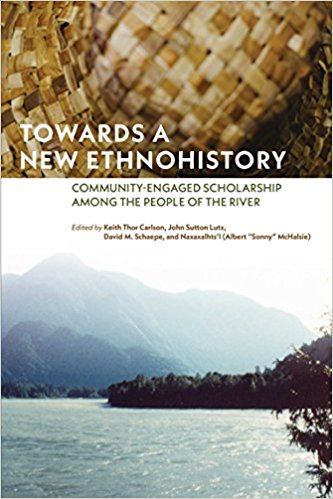 Towards a New Ethnohistory: Community-engaged Scholarship Among the People of the River. University of Manitoba Press, 2018.
From the Publisher:
"Towards a New Ethnohistory" engages respectfully in cross-cultural dialogue and interdisciplinary methods to co-create with Indigenous people a new, decolonized ethnohistory. This new ethnohistory reflects Indigenous ways of knowing and is a direct response to critiques of scholars who have for too long foisted their own research agendas onto Indigenous communities. Community-engaged scholarship invites members of the Indigenous community themselves to identify the research questions, host the researchers while they conduct the research, and participate meaningfully in the analysis of the researchers’ findings."
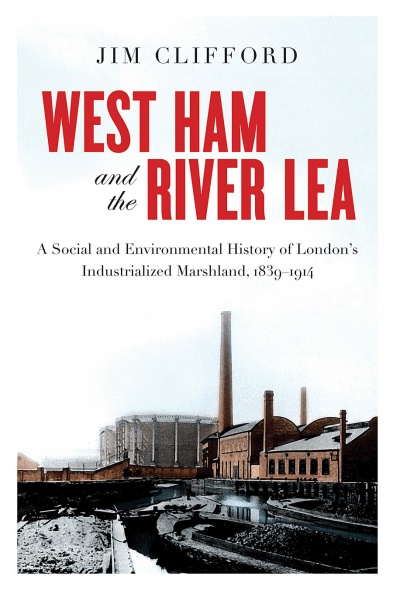 West Ham and the River Lea: A Social and Environmental History of London's Industrialized Marshland, 1839-1914. University of British Columbia Press, 2017.
From the Publisher:
"During the nineteenth century, London’s population grew by more than five million as people flocked from the countryside to the city to take up jobs in shops and factories. In West Ham and the River Lea, Jim Clifford explores the growth of London’s most populous independent suburb and the degradation of its second largest river, bringing to light the consequences of these developments on social democracy and urban politics in Greater London.
Drawing on Ordnance Surveys and archival materials, Jim Clifford uses historical geographic information systems to map the migration of Greater London’s industry into West Ham’s marshlands and reveals the consequences for the working-class people who lived among the factories. He argues that an unstable and unhealthy environment fuelled protest and political transformation. Poverty, pollution, water shortages, infectious disease, floods, and an unemployment crisis led the public to demand new forms of government intervention and provided an opening for new urban politics to emerge."
 Managing Madness: Weyburn Mental Hospital and the Transformation of Psychiatric Care in Canada. University of Manitoba Press, 2017.
From the Publisher:
"The Saskatchewan Mental Hospital at Weyburn has played a significant role in the history of psychiatric services, mental health research, and community care in Canada. Its history provides a window to the changing nature of mental health services over the twentieth century.
Built in 1921, the Saskatchewan Mental Hospital was billed as the last asylum in North America and the largest facility of its kind in the British Commonwealth. A decade later, the Canadian Committee for Mental Hygiene cited it as one of the worst institutions in the country, largely due to extreme overcrowding. In the 1950s, the Saskatchewan Mental Hospital again attracted international attention for engaging in controversial therapeutic interventions, including treatments using LSD.
Managing Madness examines the Weyburn mental hospital, the people it housed, struggled to understand, help, or even tried to change, and the ever-shifting understanding of mental health."
Awarded:
Canadian Historical Association Clio Award for Best Book in Prairie History, 2018.
 Prairie Fairies: A history of Queer Communities and People in Western Canada, 1930-1985. University of Toronto Press, 2018.
From the Publisher:
 The Enlightenment of Thomas Beddoes: Science, Medicine, and Reform. Routledge, 2017.
From the Publisher:
"Thomas Beddoes (1760-1808) lived in ‘decidedly interesting times’ in which established orders in politics and science were challenged by revolutionary new ideas. Enthusiastically participating in the heady atmosphere of Enlightenment debate, Beddoes' career suffered from his radical views on politics and science. Denied a professorship at Oxford, he set up a medical practice in Bristol in 1793. Six years later - with support from a range of leading industrialists and scientists including the Wedgwoods, Erasmus Darwin, James Watt, James Keir and others associated with the Lunar Society - he established a Pneumatic Institution for investigating the therapeutic effects of breathing different kinds of ‘air’ on a wide spectrum of diseases.
Highlighting the breadth of Beddoes’ concerns in politics, chemistry, medicine, geology, and education (including the use of toys and models), this book reveals how his reforming and radical zeal were exemplified in every aspect of his public and professional life, and made for a remarkably coherent program of change. He was frequently a contrarian, but not without cause, as becomes apparent once he is viewed in the round, as part of the response to the politics and social pressures of the late Enlightenment."
 The Romance of Science: Essays in Honour of Trevor H. Levere. Springer, 2017.
From the Publisher:
"The Romance of Science pays tribute to the wide-ranging and highly influential work of Trevor Levere, historian of science and author of Poetry Realised in Nature, Transforming Matter, Science and the Canadian Arctic, Affinity and Matter and other significant inquiries in the history of modern science. Expanding on Levere’s many themes and interests, The Romance of Science assembles historians of science -- all influenced by Levere's work -- to explore such matters as the place and space of instruments in science, the role and meaning of science museums, poetry in nature, chemical warfare and warfare in nature, science in Canada and the Arctic, Romanticism, aesthetics and morals in natural philosophy, and the “dismal science” of economics. The Romance of Science explores the interactions between science's romantic, material, institutional and economic engagements with Nature."
 A Culture's Catalyst: Historical Encounters with Peyote and the Native American Church in Canada. University of Manitoba Press, 2016.
From the Publisher:
"In 1956, pioneering psychedelic researchers Abram Hoffer and Humphry Osmond were invited to join members of the Red Pheasant First Nation near North Battleford, Saskatchewan, to participate in a peyote ceremony hosted by the Native American Church of Canada.
Inspired by their experience, they wrote a series of essays explaining and defending the consumption of peyote and the practice of peyotism. They enlisted the help of Hoffer’s sister, journalist Fannie Kahan, and worked closely with her to document the religious ceremony and write a history of peyote, culminating in a defense of its use as a healing and spiritual agent.
Although the text shows its mid-century origins, with dated language and at times uncritical analysis, it advocates for Indigenous legal, political and religious rights and offers important insights into how psychedelic researchers, who were themselves embattled in debates over the value of spirituality in medicine, interpreted the peyote ceremony. Ultimately, they championed peyotism as a spiritual practice that they believed held distinct cultural benefits.
A Culture’s Catalyst revives a historical debate. Revisiting it now encourages us to reconsider how peyote has been understood and how its appearance in the 1950s tested Native-newcomer relations and the Canadian government’s attitudes toward Indigenous religious and cultural practices."
 The Uses of Humans in Experiment: Perspectives from the 17th to the 20th Century. Brill, 2016.
From the Publisher:
"Scientific experimentation with humans has a long history. Combining elements of history of science with history of medicine, The Uses of Humans in Experiment illustrates how humans have grappled with issues of consent, and how scientists have balanced experience with empiricism to achieve insights for scientific as well as clinical progress. The modern incarnation of ethics has often been considered a product of the second half of the twentieth century, as enshrined in international laws and codes, but these authors remind us that this territory has long been debated, considered, and revisited as a fundamental part of the scientific enterprise that privileges humans as ideal subjects for advancing research."
 Bison and People on the North American Great Plains: A Deep Environmental History. Texas A & M University Press, 2016.
From the Publisher:
"The near disappearance of the American bison in the nineteenth century is commonly understood to be the result of over-hunting, capitalist greed, and all but genocidal military policy. This interpretation remains seductive because of its simplicity; there are villains and victims in this familiar cautionary tale of the American frontier. But as this volume of groundbreaking scholarship shows, the story of the bison’s demise is actually quite nuanced.
Bison and People on the North American Great Plains brings together voices from several disciplines to offer new insights on the relationship between humans and animals that approached extinction. The essays here transcend the border between the United States and Canada to provide a continental context. Contributors include historians, archaeologists, anthropologists, paleontologists, and Native American perspective."
 A World We Have Lost: Saskatchewan Before 1905. Fifth House Books, 2016.
From the Publisher:
"A World We Have Lost examines the early history of Saskatchewan through an Aboriginal and environmental lens. Indian and mixed-descent peoples played leading roles in the story, as did the land and climate. Despite the growing British and Canadian presence, the Saskatchewan country remained Aboriginal territory. The region's peoples had their own interests and needs and the fur trade was often peripheral to their lives. Indians and Métis peoples wrangled over territory and resources, especially bison, and were not prepared to let outsiders control their lives, let alone decide their future. Native-newcomer interactions were consequently fraught with misunderstandings, sometimes painful difficulties, if not outright disputes.
By the early nineteenth century, a distinctive western society had emerged in the North-West, one that was challenged and undermined by the takeover of the region by young dominion of Canada. Settlement and development was to be rooted in the best features of Anglo-Canadian civilization, including the white race. By the time Saskatchewan entered confederation as a province in 1905, the world that Kelsey had encountered during his historic walk on the northern prairies had become a world we have lost."
Awarded:
- Governor General's Literary Award in adult non-fiction, 2016.
The Lodge We Built: 100 Years of Freemasonry in Powell River. 2016.
From the publisher:
"Leaving behind conspiracy theories, and recognizing that there are important historical questions about Freemasonry that go beyond debates over the fraternity’s medieval origins, The Lodge We Built looks at Freemasonry in the modern era within a particular community — Powell River BC. Commissioned for Triune Lodge’s 100th anniversary, this book explores the motivations of the men who established Freemasonry in Powell River, and investigates the appeal that the lodge held for so many men throughout the twentieth century. Like all Freemason’s lodges, Triune has never been merely a social club. It simultaneously worked to provide individual brethren with philosophical tools and inspiration for self-improvement, while also being committed to providing relief for brethren who had fallen on hard times and to supporting local public charities. But in Powell River, an isolated experimental industrial “garden city” created and then governed by a corporation, the Freemason’s lodge also provided a space where conversations occurred across class and ethnic divisions, and where democratic governance was exercised among men who otherwise lived and worked in a stratified world."
Canadian Pacific Coast First Nations History and Culture. Confucius Institute, 2016.
From the publisher:
"Authored by ethnohistorian Keith Thor Carlson (University of Saskatchewan) and Stó:lō elders and cultural experts Dr. Albert “Sonny” McHalsie (Naxaxalhts’i) and Dr. Frank Malloway (Siyémches), 加拿大太平洋 海岸第一民族的历史与文化 [Canadian Pacific Coast First Nations History and Culture] is the first Chinese language book to examine in detail the history and culture of Canadian Northwest Coast Indigenous people. Focusing on the 27 Coast Salish First Nations of the lower Fraser River watershed (known collectively as the Stó:lō or River People), this book forefronts indigenous perspective and experience as it describes Stó:lō culture and tells the story of colonialism in Stó:lō history. This book is a model of collaborative community-engaged scholarship (CES)."
Faculty Publication 2010-2015
 Domination and Resistance: The United States and the Marshall Islands during the Cold War. University of Hawaii Press, 2015.
From the publisher:
"Domination and Resistance illuminates the twin themes of superpower domination and indigenous resistance in the central Pacific during the Cold War, with a compelling historical examination of the relationship between the United States and the Republic of the Marshall Islands. For decision makers in Washington, the Marshall Islands represented a strategic prize seized from Japan near the end of World War II. In the postwar period, under the auspices of a United Nations Trusteeship Agreement, the United States reinforced its control of the Marshall Islands and kept the Soviet Union and other Cold War rivals out of this Pacific region. The United States also used the opportunity to test a vast array of powerful nuclear bombs and missiles in the Marshalls, even as it conducted research on the effects of human exposure to radioactive fallout.
Although these military tests and human experiments reinforced the US strategy of deterrence, they also led to the displacement of several atoll communities, serious health implications for the Marshallese, and widespread ecological degradation. Confronted with these troubling conditions, the Marshall Islanders utilized a variety of political and legal tactics—petitions, lawsuits, demonstrations, and negotiations—to draw American and global attention to their plight. In response to these indigenous acts of resistance, the United States strengthened its strategic interests in the Marshalls but made some concessions to the islanders. Under the Compact of Free Association (COFA) and related agreements, the Americans tightened control over the Kwajalein Missile Range while granting the Marshallese greater political autonomy, additional financial assistance, and a mechanism to settle nuclear claims.
Martha Smith-Norris argues that despite COFA's implementation in 1986 and Washington's pivot toward the Asia-Pacific region in the post–Cold War era, the United States has yet to provide adequate compensation to the Republic of the Marshall Islands for the extensive health and environmental damages caused by the US testing programs."
For more information, visit the publisher's website.
Facing Eugenics: Reproduction, Sterilization, and the Politics of Choice. University of Toronto Press, 2013.
From the publisher:
"Facing Eugenics is a social history of sexual sterilization operations in twentieth-century Canada. Looking at real-life experiences of men and women who, either coercively or voluntarily, participated in the largest legal eugenics program in Canada, it considers the impact of successive legal policies and medical practices on shaping our understanding of contemporary reproductive rights. The book also provides deep insights into the broader implications of medical experimentation, institutionalization, and health care in North America.
Erika Dyck uses a range of historical evidence, including medical files, court testimony, and personal records to place mental health and intelligence at the centre of discussions regarding reproductive fitness. Examining acts of resistance alongside heavy-handed decisions to sterilize people considered “unfit,” Facing Eugenics illuminates how reproductive rights fit into a broader discussion of what constitutes civil liberties, modern feminism, and contemporary psychiatric survivor and disability activism."
Nominated:
- John A. Macdonald Prize in Canadian History, Canadian Historical Association, 2014.
- Book Prize (Social Sciences), Federation for Humanities and Social Sciences, 2014/2015.
For more information, visit the publisher's website
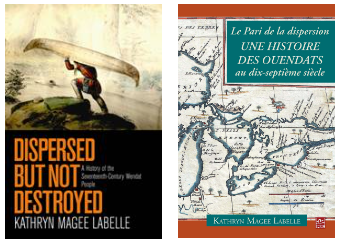
Dispersed, But Not Destroyed: A History of the Seventeenth-Century Wendat People. Vancouver: UBC Press, 2013.
Le Pari de la Dispersion: Une histoire des Ouendats au dix-septième siècle. Presses de l'Université Laval, 2014. (French Translation)
From the publisher:
"Situated within the area stretching from Georgian Bay in the north to Lake Simcoe in the east (also known as Wendake), the Wendat Confederacy flourished for two hundred years. By the mid-seventeenth century, however, Wendat society was under attack. Disease and warfare plagued the community, culminating in a series of Iroquois assaults that led to the dispersal of the Wendat people in 1649.
Yet the Wendat did not disappear, as many historians have maintained. In Dispersed but Not Destroyed, Kathryn Magee Labelle examines the creation of a Wendat diaspora in the wake of the Iroquois attacks. By focusing the historical lens on the dispersal and its aftermath, she extends the seventeenth-century Wendat narrative. In the latter half of the century, Wendat leaders continued to appear at councils, trade negotiations, and diplomatic ventures -- including the Great Peace of Montreal in 1701 -- relying on established customs of accountability and consensus. Women also continued to assert their authority during this time, guiding their communities toward paths of cultural continuity and accommodation. Through tactics such as this, the power of the Wendat Confederacy and their unique identity was maintained. Turning the story of Wendat conquest on its head, this book demonstrates the resiliency of the Wendat people and writes a new chapter in North American history."
Awarded:
- John C. Ewers Award, Western History Association, 2014.
- Best Book in Canadian Studies Prize, Canadian Studies Network - Réseau d'études canadiennes, 2013.
Nominated:
- John A. Macdonald Prize in Canadian History, Canadian Historical Association, 2014.
- Aboriginal History Prize, Canadian Historical Association, 2014.
The Transformations of Magic: Illicit Learned Magic in the Later Middle Ages and Renaissance. Penn State University Press, 2013.
"In this original, provocative, well-reasoned, and thoroughly documented book, Frank Klaassen proposes that two principal genres of illicit learned magic occur in late medieval manuscripts: image magic, which could be interpreted and justified in scholastic terms, and ritual magic (in its extreme form, overt necromancy), which could not. Image magic tended to be recopied faithfully; ritual magic tended to be adapted and reworked. These two forms of magic did not usually become intermingled in the manuscripts, but were presented separately. While image magic was often copied in the fourteenth and fifteenth centuries, The Transformations of Magic demonstrates that interest in it as an independent genre declined precipitously around 1500. Instead, what persisted was the other, more problematic form of magic: ritual magic. Klaassen shows that texts of medieval ritual magic were cherished in the sixteenth century, and writers of new magical treatises, such as Agrippa von Nettesheim and John Dee, were far more deeply indebted to medieval tradition—and specifically to the medieval tradition of ritual magic—than previous scholars have thought them to be."
- Margaret Wade Labarge Prize, Canadian Society of Medievalists, 2014.
For more information, visit the publisher’s website
From the publisher:
"Baragwanath Hospital, Soweto illustrates how this rapidly growing, underfunded but surprisingly effective institution found the niche that allowed it to exist, to provide medical care to a massive patient body and at times even to flourish in the apartheid state. The book offers new ways of exploring the history of apartheid, apartheid medicine and health care.
The long history of Chris Hani Baragwanath Hospital (its full current name) or Bara, as it’s popularly known, has been shaped by a complex set of conditions. Established in the early 1940s, Bara stands on land purchased by the Cornish immigrant John Albert Baragwanath in the late nineteenth century. He set up a refreshment post, trading store and hotel on the site – in what is now Soweto – which was a one day journey by ox-wagon from Johannesburg. The hotel became affectionately known as ‘Baragwanath Place’ (the surname is Welsh, from ‘bara’ meaning ‘bread’ and ‘gwenith’ meaning’ wheat’). The land was then bought by Corner House Mining Group and later taken over by Crown Mines Ltd. but was never mined.
The British government bought the land in the early 1940s to build a military hospital but by 1947, Baragwanath ceased to operate as a military hospital and under the auspices of the Transvaal Provincial Administration a civilian hospital was opened with 480 beds. Patients were transferred from the ‘non-European’ wing of the Johannesburg General Hospital in the ‘white’ area of Johannesburg. Links were immediately forged with the University of the Witwatersrand and Bara would over time become one of its largest teaching centres. This link brought medical students and their teachers into direct contact with apartheid in the medical sphere.
This book will contribute to studies of the history of apartheid that have begun to provide a more nuanced account of its workings. The history of Baragwanath and of the doctors and nurses who worked there tells us much about apartheid ideology and practice, as well as resistance to it, in the realm of health care."
For more information, visit the publisher's website
 The Civil Wars after 1660: Public Remembering in Late Stuart England. Rochester & Woodbridge: Boydell Press, 2013.
From the publisher:
For more information, visit the publisher's website.
 French and Indians in the Heart of North America, 1630-1815. East Lansing and Winnipeg: Michigan State University Press & University of Manitoba Press, 2013.
From the publisher:
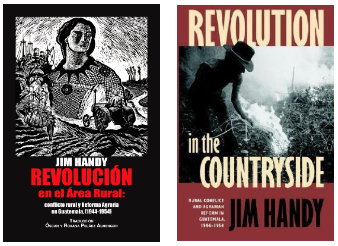 Revolution in the Countryside: Rural Conflict and Agrarian Reform in Guatemala, 1944-1954. University of North Carolina Press, 2000.
Revolución en el área rural: conflicto rural y Reforma Agraria en Guatemala (1944-1954). Centro de Estudios Urbanos y Regionale, 2013. (Spanish Translation)
From the publisher:
"Although most discussions of the Guatemalan "revolution" of 1944-54 focus on international and national politics, Revolution in the Countryside presents a more complex and integrated picture of this decade. Jim Handy examines the rural poor, both Maya and Ladino, as key players who had a decisive impact on the nature of change in Guatemala. He looks at the ways in which ethnic and class relations affected government policy and identifies the conflict generated in the countryside by new economic and social policies. Handy provides the most detailed discussion yet of the Guatemalan agrarian reform, and he shows how peasant organizations extended its impact by using it to lay claim to land, despite attempts by agrarian officials and the president to apply the law strictly. By focusing on changes in rural communities, and by detailing the coercive measures used to reverse the "revolution in the countryside" following the overthrow of President Jacobo Arbenz Guzman, Handy provides a framework for interpreting more recent events in Guatemala, especially the continuing struggle for land and democracy."
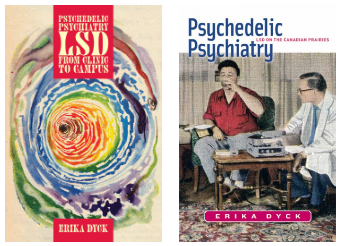 Psychedelic Psychiatry: LSD from Clinic to Campus. Johns Hopkins University Press, 2008.
Psychedelic Psychiatry: LSD on the Canadian Prairies. University of Manitoba Press, 2012. (Reprinted)
From the publisher:
"In the early 1950s, the leading centre of the world for LSD research was Weyburn, Saskatchewan, where two psychiatrists sought to revolutionize the treatment of mental illness and, in the process, gave rise to a new form of therapy: psychedelic psychiatry.
Psychedelic Psychiatry is the tale of medical researchers working to understand LSD’s therapeutic properties just as escalating anxieties about drug abuse in modern society laid the groundwork for the end of experimentation at the edge of psycho-pharmacology. Historian Erika Dyck deftly recasts our understanding of LSD to show it as an experimental substance, a medical treatment, and a tool for exploring psychotic perspectives. She recounts the inside story of the early days of LSD research in small-town, prairie Canada, when Humphry Osmond and Abram Hoffer claimed incredible advances in treating alcoholism, understanding schizophrenia and other psychoses, and achieving empathy with their patients.
In relating the drug’s short, strange trip, Dyck explains how societal concerns about countercultural trends led to the criminalization of LSD and other so-called psychedelic drugs. In this well-written and fascinating book, she confronts the ethical dilemmas of the time and challenges the prevailing wisdom behind drug regulation and addiction therapy."
For more information, visit UMP and John Hopkins.
 Edible Histories, Cultural Politics: Towards a Canadian Food History. Toronto: University of Toronto Press, 2012.
From the publisher:
"Just as the Canada's rich past resists any singular narrative, there is no such thing as a singular Canadian food tradition. This new book explores Canada's diverse food cultures and the varied relationships that Canadians have had historically with food practices in the context of community, region, nation and beyond.
Based on findings from menus, cookbooks, government documents, advertisements, media sources, oral histories, memoirs, and archival collections, Edible Histories offers a veritable feast of original research on Canada's food history and its relationship to culture and politics. This exciting collection explores a wide variety of topics, including urban restaurant culture, ethnic cuisines, and the controversial history of margarine in Canada. It also covers a broad time-span, from early contact between European settlers and First Nations through the end of the twentieth century.
Edible Histories intertwines information of Canada's 'foodways' – the practices and traditions associated with food and food preparation – and stories of immigration, politics, gender, economics, science, medicine and religion. Sophisticated, culturally sensitive, and accessible, Edible Histories will appeal to students, historians, and foodies alike."
For more information, visit the publisher's website.
Finding a Way to the Heart: Feminist Writings on Aboriginal and Women's History in Canada. Winnipeg: University of Manitoba Press, 2012.
From the publisher:
"When Sylvia Van Kirk published her groundbreaking book, Many Tender Ties, in 1980, she revolutionized the historical understanding of the North American fur trade and introduced entirely new areas of inquiry in women’s, social, and Aboriginal history. Using Van Kirk’s themes and methodologies as a jumping-off point, Finding a Way to the Heart examines race, gender, identity, and colonization from the early nineteenth to the late twentieth century, and illustrates Van Kirk’s extensive influence on a generation of feminist scholarship."
For more information, visit the publisher's website.
Gendered Intersections: A Introduction to Women's and Gender Studies. 2nd Edition. Blackpoint, Nova Scotia: Fernwood Publishing, 2011.
From the publisher:
"Following the structure of the successful first edition of Gendered Intersections, this second edition examines the intersections across and between gender, race, culture, class, ability, sexuality, age and geographical location from the diverse perspectives of academics, artists and activists. Using a variety of mediums — academic research, poetry, statistics, visual essays, fiction, emails and music — this collection offers a unique exploration of gender through issues such as Aboriginal self-governance, poverty, work, spirituality, globalization and community activism. This new edition brings a greater focus on politics, and gender and the law. It also includes access to a Gendered Intersections website, which contains several performances by poets and a Gendered Intersections Quiz, which highlights the historical and contemporary contributions of women and non-hegemonic men to Canadian society."
For more information, visit the publisher's website.
 Orality and Literacy: Reflections across Disciplines. Toronto: University of Toronto Press, 2011.
From the publisher:
"Orality and Literacy investigates the interactions of the oral and the literate through close studies of particular cultures at specific historical moments. Rejecting the 'great-divide' theory of orality and literacy as separate and opposite to one another, the contributors posit that whatever meanings the two concepts have are products of their ever-changing relationships to one another.
Through topics as diverse as Aboriginal Canadian societies, Ukrainian-Canadian narratives, and communities in ancient Greece, Medieval Europe, and twentieth-century Asia, these cross-disciplinary essays reveal the powerful ways in which cultural assumptions, such as those about truth, disclosure, performance, privacy, and ethics, can affect a society's uses of and approaches to both the written and the oral. The fresh perspectives in Orality and Literacy reinvigorate the subject, illuminating complex interrelationships rather than relying on universal generalizations about how literacy and orality function."
For more information, visit the publisher's website.
As a Farm Woman Thinks: Life and Land on the Texas High Plains, 1890–1960. Texas Tech University Press, 2010.
From the publisher:
"In twenty-five years of syndicated columns in small-town Texas newspapers between 1930 and 1960, Nellie Witt Spikes described her life on the High Plains, harking back to earlier times and reminiscing about pioneer settlement, farm and small-town culture, women’s work, and the natural history of the flatlands and canyons. Spikes’s life spanned the arrival of Euro-American settlers, the transition from ranching to farming, the drought and dust storms of the 1930s, and the irrigation revolution of the 1940s. Engaging and eloquent, her “As a Farm Woman Thinks” columns today conjure up a vivid portrait of a bygone era.
Spikes’s best pieces, organized topically and then chronologically here by Geoff Cunfer, are illuminated by black-and-white historical photographs featuring people, landscapes, small towns, farms, and ranches that populated the caprock-and-canyon country of her West Texas. Cunfer’s introduction and editorial commentary provide context.
For historians, As a Farm Woman Thinks enlarges our understanding of a wide land and its culture. For the rest of us, Spikes’s “poetry of place” still captures the spirit of the Plains and, decades later, inspires imagination and memory."
Locating Health: Historical and Anthropological Investigations of Place and Health. Pickering and Chatto Publishers, 2010.
From the publisher:
"Health and place are profoundly entwined in culture and over time. The experience of health is formed, nurtured, lived and denied in a surrounding environment. People everywhere seek out places that provide the right conditions for good health. The meanings attributed to health or illness are socially constructed, contested and shaped by powerful forces, providing an interesting arena for study.
The essays in this collection focus on the dynamic relationship between health and place. Historical and anthropological perspectives are presented, with each discipline having a long tradition of engaging with these concepts. Through diverse examples and perspectives, the resulting contributions offer new conceptual and methodological insights, enhancing both fields."
For more information, visit the publisher’s website.The Power of Place, the Problem of Time: Aboriginal Identity and Historical Consciousness in the Cauldron of Colonialism. University of Toronto Press, 2010.
From the publisher:
"The Indigenous communities of the Lower Fraser River, British Columbia (a group commonly called the Stó:lõ), have historical memories and senses of identity deriving from events, cultural practices, and kinship bonds that had been continuously adapting long before a non-Native visited the area directly. InThe Power of Place, the Problem of Time, Keith Thor Carlson re-thinks the history of Native-newcomer relations from the unique perspective of a classically trained historian who has spent nearly two decades living, working, and talking with the Stó:lõ peoples.
Stó:lõ actions and reactions during colonialism were rooted in their pre-colonial experiences and customs, which coloured their responses to events such as smallpox outbreaks or the gold rush. Profiling tensions of gender and class within the community, Carlson emphasizes the elasticity of collective identity. A rich and complex history, Carlson's study looks to both the internal and the external factors which shaped a society during a time of great change and its implications extend far beyond the study region."
Awarded:
- Aboriginal History Book Prize, Canadian Historical Association, 2011.
- Clio Award for Best History in BC Region, Canadian Historical Association, 2011.
Short listed
- Saskatchewan book award, scholarly book category
For more information, visit the publisher’s website.
Finding an Advisor
By Geography, Signature Research Area, and Methodology
Africa
- Simonne Horwitz: Aboriginal, Africa, HIV/AIDS, South Africa, Colonialism, Health, Indigenous, Oppression
Asia
- Mirela David: 20th Century China, China, Eugenics, One Child Policy, Birth Control, Culture, Gender, Gender History, Hygiene, Intellectual History, Medical History, Population, Sex, Venereal Disease
- George Keyworth: East Asian History, East Asian Religions, Medieval Chinese History, Medieval Japanese History, East Asian Buddhist Studies, History of Buddhist and Daoist Scriptures, History of Chan and Zen Buddhism, Old Japanese Manuscript Canons
Britain and the British World
- Jim Clifford: Active History, British History, British World, Canadian History, Commodities, Digital Humanities, Digital Methods, Environmental History, Historical GIS, London, Nineteenth Century, History of Public Health
- Frank Klaassen (Medieval/Renaissance): Book History, Gender and Masculinity, History of Science, Magic, Manuscripts, Palaeography and Codicology
- Matthew Neufeld: Early Modern Britain, Early Modern Europe, Healthcare, Naval and Maritime History, Peace Building, War, War and Historical Memory, War and Imperial State Formation, War and Society
- Sharon Wright (Medieval/Renaissance): Crusades, Medical, Medieval, Prairies, Conflict, Women
Canada
- Ashleigh Androsoff: Western-Canadian History, Ethnic Minority Communities, Post-Confederation Canada, Doukhobor Immigrants
- Jim Clifford: Active History, British North America, Canadian History, Commodities, Digital Humanities, Digital Methods, Environmental History, Historical GIS, London, Nineteenth Century, History of Public Health
- Erika Dyck: 20th Century, Canadian Medicine, Deinstitutionalization, Eugenics, Human Experimentation, LSD and Psychedelic Drugs, Peyote, Psychedelics, Psychiatry and Mental Health
- Robert Englebert: 18th Century, Aboriginal, British North America, Canada, Colonialism, French, Fur Trade, Governance, Illinois Country, Indigenous, Law, Louisiana, Merchants, Métissage, Pre-Industrial Quebec, United States, Upper Louisiana, Voyageurs, Cross-cultural Research
- Valerie Korinek: Canadian Culture, Food Studies, Gender, Popular Culture, Prairie, Sexuality, Social Justice
- Kathryn Labelle: Aboriginal, Wendat, Colonialism, Indigenous, North America, Women
- Cheryl Troupe: 19th and 20th Century, Métis History, Indigenous History, Environmental and Food History, Gender, Indigenous Research Methodologies, Community-Engaged Research, Historical GIS
- Andrew Watson: 19th and 20th Century, North America, Ontario, Environmental History, Energy History, Indigenous History, Sustainability, Agriculture, Tourism, Social Metabolism, Historical GIS
Caribbean
- Jim Handy: 19th Century Capitalism, Central America, Guatemala, Latin America, Peasant Dispossession, Community, Development, Environmental History, Human Rights
Modern Europe
- Ashleigh Androsoff (Russia): Western-Canadian History, Ethnic Minority Communities, Post-Confederation Canada, Doukhobor Immigrants
- Mark Meyers (France): Cultural History, Culture, Fascism, Feminist Theory, France, Gender, Homosexuality, Intellectual History, Literature, Mass Media, Memory, Postmodernism, Sexuality
- Matthew Neufeld (Germany): Early Modern Britain, Early Modern Europe, Healthcare, Naval and Maritime History, Peace Building, War, War and Historical Memory, War and Imperial State Formation, War and Society
- Alessio Ponzio: Modern European History, Italian History, History of Sexuality, Queer History, Transnational History, History of Fascism, History of Youth
Pre-modern Europe
- Angela Kalinowski (Rome/Mediterranean World): Greece, Roman History, Archaeology, Culture, Memory, Statues
- Frank Klaassen (Medieval/Renaissance Europe): Book History, Gender and Masculinity, History of Science, Magic, Manuscripts, Palaeography and Codicology
- Sharon Wright (Medieval Europe): Crusades, Medical, Medieval, Prairies, Conflict, Women
- Zachary Yuzwa (Ancient Greece and Rome; Early Middle Ages): Classical Receptions, Early Christianity, Hagiography, Late Antiquity, Later Roman Empire, Latin Literature
Latin America
- Jim Handy: 19th Century Capitalism, Central America, Guatemala, Latin America, Peasant Dispossession, Community, Development, Environmental History, Human Rights
Middle East
- Maurice Jr. Labelle: Arab Decolonization, Arab-Israeli Conflict, Edward Said, Occidentalism, Orientalism, Palestine, Postcolonialism, U.S.- Middle East Relations
United States
- Geoff Cunfer: Historical GIS, North America, Agricultural Landscapes, Digital Humanities, Environmental History, Historical Geography
- Robert Englebert: 18th Century, Aboriginal, British North America, Canada, Colonialism, French, Fur Trade, Governance, Illinois Country, Indigenous, Law, Louisiana, Merchants, Métissage, Pre-Industrial Quebec, United States, Upper Louisiana, Voyageurs, Cross-cultural Research
- Kathryn Labelle: Aboriginal, Wendat, Colonialism, Indigenous, North America, Women
- Martha Smith: 20th Century U.S. History, Cold War History, Environmental History, U.S. Foreign Relations, United States and the Asia Pacific
- Benjamin Hoy: Aboriginal History, Borderlands History, Canada, Demography, United States, Border Control, Game-based Learning
- Andrew Watson: 19th and 20th Century, North America, Ontario, Environmental History, Energy History, Indigenous History, Sustainability, Agriculture, Tourism, Social Metabolism, Historical GIS
Colonial and Post-Colonial Histories
- Jim Clifford: Active History, British History, British World, Commodities, Digital Humanities, Digital Methods, Environmental History, HGIS, London, Nineteenth Century, History of Public Health
- Robert Englebert: 18th Century, Aboriginal, British North America, Canada, Colonialism, French, Fur Trade, Governance, Illinois Country, Indigenous, Law, Louisiana, Merchants, Métissage, Pre-Industrial Quebec, United States, Upper Louisiana, Voyageurs, Cross-cultural Research
- Jim Handy: 19th Century Capitalism, Central America, Guatemala, Latin America, Peasant Dispossession, Community, Development, Environmental History, Human Rights
- Simonne Horwitz: Aboriginal, Africa, HIV/AIDS, South Africa, Colonialism, Health, Indigenous, Oppression
- Kathryn Labelle: Aboriginal, Wendat, Colonialism, Indigenous, North America, Women
- Maurice Jr. Labelle: Arab Decolonization, Arab-Israeli Conflict, Edward Said, Occidentalism, Orientalism, Palestine, Postcolonialism, U.S.- Middle East Relations
History and Politics of Memory
- Ashleigh Androsoff: Western-Canadian history, Ethnic Minority Communities, Post-Confederation Canada, Doukhobor Immigrants
- Jim Handy: 19th Century Capitalism, Central America, Guatemala, Latin America, Peasant Dispossession, Community, Development, Environmental History, Human Rights
- Angela Kalinowski: Greece, Roman history, Archaeology, Culture, Memory, Statues
- Mark Meyers: Cultural History, Culture, Fascism, Feminist Theory, France, Gender, Homosexuality, Intellectual History, Literature, Mass Media, Memory, Postmodernism, Sexuality
- Zachary Yuzwa: Classical Receptions, Early Christianity, Hagiography, Late Antiquity, Later Roman Empire, Latin Literature
Classical, Medieval, and Renaissance Studies
- Angela Kalinowski: Greece, Roman History, Archaeology, Culture, Memory, Statues
- Frank Klaassen: Book History, Gender and Masculinity, History of Science, Magic, Manuscripts, Palaeography and Codicology
- John Porter: Greek History, Latin Literature, Roman History, Culture, Drama
- Lewis Stiles: Medical and Scientific Terminology, Etymology, Greek and Latin Poetry, Classics
- Sharon Wright: Crusades, Medical, Medieval, Prairies, Conflict, Women
- Zachary Yuzwa: Classical Receptions, Early Christianity, Hagiography, Late Antiquity, Later Roman Empire, Latin Literature
Prairies and the North American West
- Ashleigh Androsoff: Western-Canadian history, Ethnic Minority Communities, Post-Confederation Canada, Doukhobor Immigrants
- Geoff Cunfer: HGIS, North America, Agricultural Landscapes, Digital Humanities, Environmental History, Historical Geography
- Benjamin Hoy: Aboriginal History, Borderlands History, Canada, Demography, United States, Border Control, Game-based Learning
- Valerie Korinek: Canadian Culture, Food Studies, Gender, Popular Culture, Prairie, Sexuality, Social Justice
- Cheryl Troupe: 19th and 20th Century, Métis History, Indigenous History, Environmental and Food History, Gender, Indigenous Research Methodologies, Community-Engaged Research, Historical GIS
Gender and Sexualities
- Ashleigh Androsoff: Western-Canadian History, Ethnic Minority Communities, Post-Confederation Canada, Doukhobor Immigrants
- Mirela David: 20th Century China, China, Eugenics, One Child policy, Birth Control, Culture, Gender, Gender History, Hygiene, Intellectual History, Medical History, Population, Sex, Venereal Disease
- Simonne Horwitz: Aboriginal, Africa, HIV/AIDS, South Africa, Colonialism, Health, Indigenous, Oppression
- Frank Klaassen: Book History, Gender and Masculinity, History of Science, Magic, Manuscripts, Palaeography and Codicology
- Valerie Korinek: Canadian Culture, Food Studies, Gender, Popular Culture, Prairie, Sexuality, Social Justice
- Kathryn Labelle: Aboriginal, Wendat, Colonialism, Indigenous, North America, Women
- Mark Meyers: Cultural History, Culture, Fascism, Feminist Theory, France, Gender, Homosexuality, Intellectual History, Literature, Mass Media, Memory, Postmodernism, Sexuality
- Alessio Ponzio: Modern European History, Italian History, History of Sexuality, Queer History, Transnational History, History of Fascism, History of Youth
- Sharon Wright: Crusades, Medical, Medieval, Prairies, Conflict, Women
- Zachary Yuzwa: Classical Receptions, Early Christianity, Hagiography, Late Antiquity, Later Roman Empire, Latin Literature
Environmental History
- Geoff Cunfer: HGIS, North America, Agricultural Landscapes, Digital Humanities, Environmental History, Historical Geography
- Jim Clifford: Active History, British History, British World, Commodities, Digital Humanities, Digital Methods, Environmental History, HGIS, London, Nineteenth Century, History of Public Health
- Jim Handy: 19th Century Capitalism, Central America, Guatemala, Latin America, Peasant Dispossession, Community, Development, Environmental History, Human Rights
- Martha Smith: 20th Century U.S. History, Cold War History, Environmental History, U.S. Foreign Relations, United States and the Asia Pacific
- Cheryl Troupe: 19th and 20th Century, Métis History, Indigenous History, Environmental and Food History, Gender, Indigenous Research Methodologies, Community-Engaged Research, Historical GIS
- Andrew Watson: 19th and 20th Century, North America, Ontario, Environmental History, Energy History, Indigenous History, Sustainability, Agriculture, Tourism, Social Metabolism, Historical GIS
Indigenous History
- Robert Englebert: 18th Century, Aboriginal, British North America, Canada, Colonialism, French, Fur Trade, Governance, Illinois Country, Indigenous, Law, Louisiana, Merchants, Métissage, Pre-Industrial Quebec, United States, Upper Louisiana, Voyageurs, Cross-cultural Research
- Jim Handy: 19th Century Capitalism, Central America, Guatemala, Latin America, Peasant Dispossession, Community, Development, Environmental History, Human Rights
- Benjamin Hoy: Aboriginal History, Borderlands History, Canada, Demography, United States, Border Control, Game-based Learning
- Kathryn Labelle: Aboriginal, Wendat, Colonialism, Indigenous, North America, Women
- Cheryl Troupe: 19th and 20th Century, Métis History, Indigenous History, Environmental and Food History, Gender, Indigenous Research Methodologies, Community-Engaged Research, Historical GIS
Health, Medicine, Science and Occultism
- Ashleigh Androsoff (Health): Western-Canadian history, Ethnic Minority Communities, Post-Confederation Canada, Doukhobor Immigrants
- Jim Clifford: Active History, British History, British World, Commodities, Digital Humanities, Digital Methods, Environmental History, HGIS, London, Nineteenth Century, History of Public Health
- Mirela David (Health and Medicine): 20th Century China, China, Eugenics, One Child Policy, Birth Control, Culture, Gender, Gender History, Hygiene, Intellectual History, Medical History, Population, Sex, Venereal Disease
- Erika Dyck (Health and Medicine): 20th Century, Canadian Medicine, Deinstitutionalization, Eugenics, Human Experimentation, LSD and Psychedelic Drugs, Peyote, Psychedelics, Psychiatry and Mental Health
- Simonne Horwitz: Aboriginal, Africa, HIV/AIDS, South Africa, Colonialism, Health, Indigenous, Oppression
- Frank Klaassen (Science, Medicine, and Occultism): Book History, Gender and Masculinity, History of Science, Magic, Manuscripts, Palaeography and Codicology
- Matthew Neufeld: Early Modern Britain, Early Modern Europe, Healthcare, Naval and Maritime History, Peace Building, War, War and Historical Memory, War and Imperial State Formation, War and Society
- Sharon Wright (Medicine): Crusades, Medical, Medieval, Prairies, Conflict, Women
Twentieth Century Politics, Culture, and Foreign Relations
- Ashleigh Androsoff: Western-Canadian History, Ethnic Minority Communities, Post-Confederation Canada, Doukhobor Immigrants
- Mirela David: 20th Century China, China, Eugenics, One Child Policy, Birth Control, Culture, Gender, Gender History, Hygiene, Intellectual History, Medical History, Population, Sex, Venereal Disease
- Erika Dyck: 20th Century, Canadian Medicine, Deinstitutionalization, Eugenics, Human Experimentation, LSD and Psychedelic Drugs, Peyote, Psychedelics, Psychiatry and Mental Health
- Jim Handy: 19th Century Capitalism, Central America, Guatemala, Latin America, Peasant Dispossession, Community, Development, Environmental History, Human Rights
- Simonne Horwitz: Aboriginal, Africa, HIV/AIDS, South Africa, Colonialism, Health, Indigenous, Oppression
- Valerie Korinek: Canadian Culture, Food Studies, Gender, Popular Culture, Prairie, Sexuality, Social Justice
- Maurice Jr. Labelle: Arab Decolonization, Arab-Israeli Conflict, Edward Said, Occidentalism, Orientalism, Palestine, Postcolonialism, U.S.- Middle East Relations
- Mark Meyers: Cultural History, Culture, Fascism, Feminist Theory, France, Gender, Homosexuality, Intellectual History, Literature, Mass Media, Memory, Postmodernism, Sexuality
- Martha Smith: 20th Century U.S. History, Cold War History, Environmental History, U.S. Foreign Relations, United States and the Asia Pacific
Oral History
- Ashleigh Androsoff: Western-Canadian History, Ethnic Minority Communities, Post-Confederation Canada, Doukhobor Immigrants
- Simonne Horwitz: Aboriginal, Africa, HIV/AIDS, South Africa, Colonialism, Health, Indigenous, Oppression
- Valerie Korinek: Canadian Culture, Food Studies, Gender, Popular Culture, Prairie, Sexuality, Social Justice
- Kathryn Labelle: Aboriginal, Wendat, Colonialism, Indigenous, North America, Women
- Cheryl Troupe: 19th and 20th Century, Métis History, Indigenous History, Environmental and Food History, Gender, Indigenous Research Methodologies, Community-Engaged Research, Historical GIS
Ethnohistory
- Ashleigh Androsoff: Western-Canadian History, Ethnic Minority Communities, Post-Confederation Canada, Doukhobor Immigrants
- Robert Englebert: 18th Century, Aboriginal, British North America, Canada, Colonialism, French, Fur Trade, Governance, Illinois Country, Indigenous, Law, Louisiana, Merchants, Métissage, Pre-Industrial Quebec, United States, Upper Louisiana, Voyageurs, Cross-cultural Research
- Jim Handy: 19th Century Capitalism, Central America, Guatemala, Latin America, Peasant Dispossession, Community, Development, Environmental History, Human Rights
- Simonne Horwitz: Aboriginal, Africa, HIV/AIDS, South Africa, Colonialism, Health, Indigenous, Oppression
- Kathryn Labelle: Aboriginal, Wendat, Colonialism, Indigenous, North America, Women
- Cheryl Troupe: 19th and 20th Century, Métis History, Indigenous History, Environmental and Food History, Gender, Indigenous Research Methodologies, Community-Engaged Research, Historical GIS
Manuscript and Inscription Studies
- Angela Kalinowski: Greece, Roman history, Archaeology, Culture, Memory, Statues
- George Keyworth: East Asian History, East Asian Religions, Medieval Chinese History, Medieval Japanese History, East Asian Buddhist Studies, History of Buddhist and Daoist Scriptures, History of Chan and Zen Buddhism, Old Japanese Manuscript Canons
- Frank Klaassen: Book History, Gender and Masculinity, History of Science, Magic, Manuscripts, Palaeography and Codicology
- Sharon Wright: Crusades, Medical, Medieval, Prairies, Conflict, Women
- Zachary Yuzwa: Classical Receptions, Early Christianity, Hagiography, Late Antiquity, Later Roman Empire, Latin Literature
Community-Engaged Research
- Ashleigh Androsoff: Western-Canadian History, Ethnic Minority Communities, Post-Confederation Canada, Doukhobor Immigrants
- Erika Dyck: 20th Century, Canadian Medicine, Deinstitutionalization, Eugenics, Human Experimentation, LSD and Psychedelic Drugs, Peyote, Psychedelics, Psychiatry and Mental Health
- Kathryn Labelle: Aboriginal, Wendat, Colonialism, Indigenous, North America, Women
- Cheryl Troupe: 19th and 20th Century, Métis History, Indigenous History, Environmental and Food History, Gender, Indigenous Research Methodologies, Community-Engaged Research, Historical GIS
- Andrew Watson: 19th and 20th Century, North America, Ontario, Environmental History, Energy History, Indigenous History, Sustainability, Agriculture, Tourism, Social Metabolism, Historical GIS
Historical GIS and Digital History
- Jim Clifford: Active History, British History, British World, Commodities, Digital Humanities, Digital Methods, Environmental History, HGIS, London, Nineteenth Century, History of Public Health
- Geoff Cunfer: HGIS, North America, Agricultural Landscapes, Digital Humanities, Environmental History, Historical Geography
- Benjamin Hoy: Aboriginal History, Borderlands History, Canada, Demography, United States, Border Control, Game-based Learning
- Cheryl Troupe: 19th and 20th Century, Métis History, Indigenous History, Environmental and Food History, Gender, Indigenous Research Methodologies, Community-Engaged Research, Historical GIS
- Andrew Watson: 19th and 20th Century, North America, Ontario, Environmental History, Energy History, Indigenous History, Sustainability, Agriculture, Tourism, Social Metabolism, Historical GIS
Cultural and Discursive History
- Ashleigh Androsoff: Western-Canadian History, Ethnic Minority Communities, Post-Confederation Canada, Doukhobor Immigrants
- Mirela David: 20th Century China, China, Eugenics, One Child Policy, Birth Control, Culture, Gender, Gender History, Hygiene, Intellectual History, Medical History, Population, Sex, Venereal Disease
- Robert Englebert: 18th Century, Aboriginal, British North America, Canada, Colonialism, French, Fur Trade, Governance, Illinois Country, Indigenous, Law, Louisiana, Merchants, Métissage, Pre-Industrial Quebec, United States, Upper Louisiana, Voyageurs, Cross-cultural Research
- Jim Handy: 19th Century Capitalism, Central America, Guatemala, Latin America, Peasant Dispossession, Community, Development, Environmental History, Human Rights
- Simonne Horwitz: Aboriginal, Africa, HIV/AIDS, South Africa, Colonialism, Health, Indigenous, Oppression
- Angela Kalinowski: Greece, Roman history, Archaeology, Culture, Memory, Statues
- Valerie Korinek: Canadian Culture, Food Studies, Gender, Popular Culture, Prairie, Sexuality, Social Justice
- Maurice Jr. Labelle: Arab Decolonization, Arab-Israeli Conflict, Edward Said, Occidentalism, Orientalism, Palestine, Postcolonialism, U.S.- Middle East Relations
- Mark Meyers: Cultural History, Culture, Fascism, Feminist Theory, France, Gender, Homosexuality, Intellectual History, Literature, Mass Media, Memory, Postmodernism, Sexuality
- Andrew Watson: 19th and 20th Century, North America, Ontario, Environmental History, Energy History, Indigenous History, Sustainability, Agriculture, Tourism, Social Metabolism, Historical GIS
- Zachary Yuzwa: Classical Receptions, Early Christianity, Hagiography, Late Antiquity, Later Roman Empire, Latin Literature
Transnational Research
- Ashleigh Androsoff: Western-Canadian History, Ethnic Minority Communities, Post-Confederation Canada, Doukhobor Immigrants
- Mirela David: 20th Century China, China, Eugenics, One Child Policy, Birth Control, Culture, Gender, Gender History, Hygiene, Intellectual History, Medical History, Population, Sex, Venereal Disease
- Robert Englebert: 18th Century, Aboriginal, British North America, Canada, Colonialism, French, Fur Trade, Governance, Illinois Country, Indigenous, Law, Louisiana, Merchants, Métissage, Pre-Industrial Quebec, United States, Upper Louisiana, Voyageurs, Cross-cultural Research
- Benjamin Hoy: Aboriginal History, Borderlands History, Canada, Demography, United States, Border Control, Game-based Learning
- Jim Handy: 19th Century Capitalism, Central America, Guatemala, Latin America, Peasant Dispossession, Community, Development, Environmental History, Human Rights
- Kathryn Labelle: Aboriginal, Wendat, Colonialism, Indigenous, North America, Women
- Maurice Jr. Labelle: Arab Decolonization, Arab-Israeli Conflict, Edward Said, Occidentalism, Orientalism, Palestine, Postcolonialism, U.S.- Middle East relations
- Martha Smith: 20th Century U.S. History, Cold War History, Environmental History, U.S. Foreign Relations, United States and the Asia Pacific
- Andrew Watson: 19th and 20th Century, North America, Ontario, Environmental History, Energy History, Indigenous History, Sustainability, Agriculture, Tourism, Social Metabolism, Historical GIS