

Welcome
Space and Atmospheric Studies
| On almost any night, the aurora dances across the northern sky and is a manifestation of one of the more subtle connections the Earth has with its celestial guardian, the Sun. |
Focus of Studies at ISAS
The Past and Present
The Institute of Space and Atmospheric Studies (ISAS) was formed in 1956 to study the aurora (northern lights), the related 'disturbances' in the upper atmosphere and ionosphere, and the effects of solar activity upon climate. Since that time members of the Institute have expanded the world's knowledge and understanding of how the sun and the earth interact; and trained more than 200 scientists and engineers in a wide range of technical and scientific areas. ISAS developed observing systems for space and atmospheric sciences, ground based optical and radar instruments, and satellite systems, remote sensing technology, and knowledge of STP processes are a vital resource for "Canadian Space Science" and couples powerfully into high-technology industries.
Currently the Institute consists of approximately 37 persons: 7 Physics and Engineering Physics professors who are also Principal Investigators of ISAS programs (plus 4 Emeriti), 4 Adjunct Professors, 3 Research Associates, 12 Research Assistants and Engineers, 3 Post Doctoral Fellows, 2 Project Coordinators, 1 Project Manager, and 1 Clerical Admininstrative staff, as well as 19 Grad Students. It is the largest and most comprehensive Solar-Terrestrial Physics (STP) and Atmospheric Science Institute in Canada. The members of ISAS work in conjunction with other Canadians and with international teams of scientists, engineers, and technologists. Out colleagues are in Eruope, Scandanavia, Russia, China, India, Australia, Africa, South America, the United States, and Japan.
ISAS's research activities are supported by the University of Saskatchewan, the Canadian Space Agency (CSA), the Natural Science and Engineering Research Council (NSERC) through grants to individual professors, and the Meteorological Service of Canada (MSC).
ISAS Professors
Assistant Professor
Department of Physics and Engineering Physics
(306) 966-6605
(306) 966-6400
daniel.billett@usask.ca
Ph.D. (Lancaster University, UK) 2019
M.Phys. (Aberystwyth University, UK) 2015
Dr. Billett’s research has focused on the impact of space weather on Earth’s upper high latitude
atmosphere. His research has focused on several aspects of the “chain of events” that cause space weather to have an impact on human life. This research begins with an examination of how the interplanetary solar wind interacts with the Earth’s magnetosphere, transferring electromagnetic energy into the Earth’s atmospheric system and driving plasma circulation at high latitudes. Dr Billett has focused heavily on how air in the upper atmosphere (the thermosphere) is affected by these kinds of events, and how potentially dangerous conditions for low-Earth-orbit satellites are formed.
As Assistant Director of the Canadian arm of the Super Dual Auroral Radar Network (SuperDARN), Dr. Billett is also interested in the development of high-frequency Over-The-Horizon (OTH) radar systems for space weather monitoring. In addition to SuperDARN, Dr. Billett utilises numerous other instruments for ionospherethermosphere science, including ESA’s Swarm satellite constellation and the Active Magnetosphere and Planetary Electrodynamics Response Experiment (AMPERE).
Professor
Department of Physics and Engineering Physics
(306) 966-1418
(306) 966-6400
adam.bourassa@usask.ca
Ph.D. (USask) 2007
Dr. Bourassa, a member of the Institute of Space and Atmospheric Studies, is actively involved in the development of satellite based remote sensing measurement and inversion techniques that are able to probe the atmosphere globally, frequently and repetitively. The data that these techniques can provide are invaluable to understanding and monitoring atmospheric processes. Primarily, his work has been as a member of science team for the Canadian Optical Spectrograph and InfraRed Imaging System (OSIRIS), a satellite instrument designed and built in Canada and currently deployed on the Swedish Odin satellite, and with the Ozone Mapping and Profiling Suite Limb Profiler that is under development at the NASA Langley Research Center. These instruments observe the side, or limb, view of sunlight scattered from the atmosphere. The spectrum of light from the sun, in the process of traveling through the atmosphere and scattering off molecules and particles, possibly several times, is imprinted with the signatures of the atmospheric composition. The great benefit of this relatively new technique is the ability to globally measure the vertical structure of the atmosphere.
Dr. Bourassa is particularly interested in measurements and impacts of aerosols in the upper troposphere and stratosphere. Stratospheric sulphate aerosols are an important type of aerosol due to their effects on climate and ozone and are generally quite difficult to measure at background levels. This thin, fine mist of particles exists naturally, but is highly variable as volcanic eruptions and anthropogenic pollution can strongly modify the concentration of stratospheric aerosol on a global level. The development of radiative transfer modeling and inversion methods for these and other aerosols, including clouds, smoke and dust are a focus of Dr. Bourassa’s current work. Understanding the radiative and chemical effects of these aerosols is a key component in the study of long term atmospheric trends required for further understanding of the Earth’s climate system. These studies are also leading to the development of designs for future optical instrumentation for sub-orbital and space-based remote sensing missions.
Professor
Department of Physics and Engineering Physics
(306) 966-6447
(306) 966-6400
doug.degenstein@usask.ca
Ph.D. (USask) 1999
Dr. Degenstein has been a member of the University of Saskatchewan faculty since the autumn of 1999. Dr. Degenstein specializes in the remote sensing of the atmosphere through optical means with a primary focus on satellite based optical instrumentation. Dr. Degenstein is the Principal Investigator (PI) of OSIRIS, the Optical Spectrograph and InfraRed Imager System. OSIRIS is the Canadian Space Agency (CSA) contribution to the multi-national, Swedish led, Odin mission. This mission has a fundamental goal to better understand the photochemistry and dynamics associated with arctic ozone and its depletion. Dr. Degenstein is currently an executive member of the Atmospheric Science Advisory Committee (ASAC), which has a mandate to advise the CSA with respect to atmospheric science. He is also the past chair of the Division of Aeronomy and Space Physics (DASP) within the Canadian Association of Physicists.
Dr. Degenstein has been part of the OSIRIS project since the summer of 1993. As a Ph.D. graduate student working with Dr. E.J. (Ted) Llewellyn, the original OSIRIS PI, Dr. Degenstein was involved in almost every aspect of OSIRIS including: design; construction; calibration; characterization; commissioning; validation and analysis of the scientific data stream. As faculty at the University of Saskatchewan Dr. Degenstein has primarily been involved with the analysis of OSIRIS data for the purpose of studying the dynamics and photo-chemistry of the upper troposphere, the stratosphere and the mesosphere.
Professor
Department of Physics and Engineering Physics
(306) 966-6442
(306) 966-6400
Glenn.hussey@usask.ca
B.E., M.Sc., Ph.D. (USask)
Dr. Hussey's research interests centre around the ionospheric E-region, both at the high- and mid-latitudes as well as the high-latitude ionospheric F-region. His E-region research focuses on a better understanding of the physics of the excitation process of naturally occurring plasma wave instabilities which occur in this region of the ionosphere. The E-region is the transition region between the neutral atmosphere below and the ionised near-Earth space environment above. The dynamics in the neutral atmosphere is dominated by winds and motions of the neutral atmosphere and the weakly ionised region above the E-region is dominated by electrodynamic motions of the charged particles, while the E-region is a combination of neutral and electrodynamics to varying degrees.
In the mid-latitude E-region the contribution of bulk neutral motions on the excitation of plasma instabilities dominate; whereas, the high-latitude E-region is much more dominated by coupling with the upper ionosphere (F-region) and magnetosphere where neutral affects are much more difficult to detect and/or less significant compared to electrodynamical ones. My research focuses on better understanding these plasma processes in the E-region by probing them using coherent backscatter radars both at VHF and HF frequencies. Analysis of the received coherent radar echoes are compare to currently proposed theories and models. Part of my research has involved developing and implementing a novel VHF radar system with unprecedented high spatial and temporal resolution for probing the very dynamical coherent radar backscatter associated with the E-region.
Dr. Hussey is also the director of the SuperDARN radar group situated here at the University of Saskatchewan. A SuperDARN radar is an HF coherent backscatter radar used to probe the ionosphere. It is optimised to study the F-region of the ionosphere, for magnetospheric studies, but also can study other regions such as the E-region. SuperDARN is a very versatile experiment and can be used for many types of near-Earth space science, either ground-based, satellite-based, or both. The ePOP satellite, to be launched in 2009, has one experiment where SuperDARN supplies the radio signal to be received by a radio receiver instrument on the satellite. This experiment will allow for trans-ionospheric studies of radio waves as they propagate through the terrestrial ionosphere. In anticipation of the satellite launch, modelling of the expected signal is currently in progress.
Professor
Department of Physics and Engineering Physics
(306) 966-6426
(306) 966-6400
sasha.koustov@usask.ca
University Diploma (equiv. M.Sc.) (U of St-Petersburg, Dept. of Radio Physics, Russia) 1977
Candidate of Physical-Mathematical Sciences (equiv. Ph.D.) (Moscow Institute of the Physics of the Earth, Russia) 1986
Dr. Koustov is interested in studying Sun's influences on the Earth's upper atmosphere and ionosphere via electrodynamical processes by involving data from a variety of instruments on the ground and in space. Among targets of investigation are mechanisms of the solar wind energy entry into the upper atmosphere and establishing of plasma circulation at various ionospheric heights. Research is based on data collected by various ground-based radars such powerful incoherent scatter radars, coherent HF SuperDARN radars and other radio systems. Another significant area of research is plasma physics of small-scale irregularity formation in the ionosphere at various heights and latitudes. Such irregularities are responsible for the onset of coherent echoes and thus ultimately determine the capabilities of coherent radars in studying the plasma flows in the ionosphere and above.
Kathryn McWilliams (PhD, PEng, FRAS), Professor of Space Physics at the University of Saskatchewan and Director of the Super Dual Auroral Radar Network (SuperDARN) Canada National Research Facility, passed away at her home in Saskatoon on January 3, 2025, after a short illness.
After Kathryn finished her Master's at the University of Saskatchewan, she went on to complete a PhD at the University of Leicester in the UK on a prestigious Commonwealth scholarship. She then came back to USask as a postdoc in 2002, before quickly becoming a professor in 2004. At USask, Kathryn became the first ever female tenured faculty member in Physics. In 2022, she became the first Canadian ever to be recognised as a fellow of the Royal Astronomical Society of the United Kingdom.
Kathryn McWilliams was SuperDARN, and SuperDARN was her. She was there from the very beginning – building the Saskatoon antenna array in 1993 when she was a summer student and leaving her handprint in one of the cement bases. Her memory will echo there, and at her four other radars, for years to come.
Her enthusiasm for this field, her radars, her colleagues, her students, her engineers, was boundless and inspirational. The way she spoke with those not in our field was passionate and loving. And to those in our field, she would lift high above herself. There are many examples, but one shining achievement is the CaNoRock Canada-Norway rocket launch program, which she led, and resulted in the funding of over 250 Canadian students in graduate programmes.
Kathryn was a true leader and an incredible human being. Many of us will remember her for the sincere generosity she gave in every aspect of her life. We should all strive to be more like her. She built countless people up to love her field, and her absence now at the University of Saskatchewan, within the international SuperDARN community, CAP/DASP, CEDAR, GEM, and MIST communities, has been, and will continue to be, extremely painful for all of us. The world has lost an astounding scientist and person, and the international space science community mourns this loss together with Kathryn’s family.
Assistant Professor
Department of Physics and Engineering Physics
(306) 966-6457
(306) 966-6400
susan.tegtmeier@usask.ca
Ph.D. in Physics (University Potsdam) 2007
M.Sc. in Mathematics (Humboldt University Berlin, Germany) 2002
Dr. Tegtmeier’s research centres around chemistry-climate interactions in the troposphere and stratosphere. One focus is on marine halogenated and sulfur-containing substances and their role in the atmosphere. Her work investigates industrial and agricultural sources of these gases and their current and future impact on the ozone layer based on observational and model data. These studies provide important contribution to understanding and predicting the impact of new anthropogenic activities on atmospheric chemistry and climate.
A second focus of Dr. Tegtmeier’s research is on the dynamical coupling between stratospheric and tropospheric processes. She investigates the tropical tropopause layer (TTL), the transition region between the troposphere and stratosphere, based on a hierarchy of computational models as well as observational and reanalyses data. The TTL sets the boundary conditions for stratospheric chemistry and composition and at the same allows for stratospheric signals to impact tropospheric dynamics. A key aspect of Dr. Tegtmeier’s work are long-term changes of the TTL structure and the link between stratospheric signals such as the quasi-biennial oscillation and tropical weather phenomena.
Dr. Tegtmeier is involved in a number of international research projects and activities. She is a member of the Stratosphere-troposphere Processes And their Role in Climate (SPARC) Reanalysis Intercomparison Project (S-RIP) science team and the World Climate Research Programme (WCRP) ‘My Climate Risk’ Lighthouse Activity Science Plan Development team. She co-leads the World Climate Research Programme (WCRP) Data Advisory Council (WDAC) and will be lead author of Chapter 1 of the upcoming 2022 WMO/UNEP Ozone Assessment Report.
Assistant Professor
Department of Physics and Engineering Physics
(306) 966-1239
(306) 966-6400
matt.toohey@usask.ca
Ph.D. (University of Toronto) 2009
M.Sc. (University of Toronto) 2003
B.Sc. (University of British Columbia) 2001
Prof. Toohey’s research focuses on stratospheric aerosols and their impact on the Earth’s climate. His work investigates the physical processes of aerosol formation and evolution, interactions between aerosols and radiation, and the changes the aerosols produce in atmospheric circulation and surface temperatures. His team uses a hierarchy of computational models which represent physical processes on a range of scales and timescales, as well as observations and proxy data. Prof. Toohey is particularly interested in increasing understanding of the impacts large volcanic eruptions have had on past climate.
Prof. Toohey is involved in a number of international research projects. He leads the Volcanic Impacts on Climate and Society (VICS) working group of the Past Global Changes (PAGES) project. He is involved in the Stratospheric Sulfur and its Role in Climate (SSiRC) project as well as the Model Intercomparison Project on the climatic response to Volcanic forcing (VolMIP). He is an external partner of the VIKINGS project (University of Oslo), the VolImpact Research Unit (Germany) and PalMod project (Germany). He is also a contributing author to the Sixth Assessment Report of the Intergovernmental Panel on Climate Change.
Research links:
http://pastglobalchanges.org/science/wg/vics/intro
https://physik.uni-greifswald.de/ag-von-savigny/projects/dfg-research-unit-volimpact-for-2820/
https://www.mn.uio.no/geo/english/research/projects/vikings/
ISAS Emeritus Professors
Professor Emeritus
Department of Physics and Engineering Physics
(306) 966-6400
edward.llewellyn@usask.ca
FRSC, P.Eng.
Distinguished University Researcher 2002
D.Sc. (Sask) 1987
Ph.D. (Exon) 1963
B.Sc. (Exon) 1960
Dr. Llewellyn was head of the InfraRed Group in the Institute of Space and Atmospheric Studies at the University of Saskatchewan. He also served as the Principal Investigator for the OSIRIS instrument on the Odin satellite from its inception, in 1994, through to 2008. Dr. Llewellyn's research specialization and expertise is optical aeronomy, with particular emphasis on the use of airglow emissions to derive atmospheric state parameters, and on the interaction of spacecraft in low Earth orbit with the atmosphere. He is a co-Investigator for the WINDII instrument on the UARS spacecraft and for the ACE instrument on the Canadian SciSat-I satellite. He was a co-discoverer (with Drs. W.F.J. Evans FRSC, D.M. Hunten FRSC and A. Vallance Jones FRSC) of the upper ozone layer; an together with Drs. R.G.H. Greer, G. Witt, J. Stegman and B.H. Solheim he developed the idea that both the oxygen green line and the low energy molecular oxygen states are excited by energy transfer. Together with Dr. I.C. McDade he developed a set of mechanistic rate constants that can describe the airglow excitation of oxygen. He has also developed, with Dr. McDade, a new description of the processes controlling the collisional relaxation of vibrationally excited OH Another aspect of that collaboration has been the development of a tomographic analysis system that can improve our understanding of airglow distributions. This work is currently being extended by Drs. Bourassa and Degenstein.
While Dr. Llewellyn has been extensively involved with research intended to improve our understanding of the excitation mechanisms for the various airglow emissions most of the current research efforts are directed toward Odin and in particular the OSIRIS instrument, an optical spectrograph and infrared imager, on that satellite. The infrared imager makes observations that allow the application of tomographic techniques to the measurement of the oxygen infrared atmospheric bands and the Meinel OH emissions. In this work he is supported by the efforts of Dr. Richard Gattinger an adjunct faculty member. He has also developed a close collaboration with Professor John Burrows at the University of Bremen. Other related work is involved with the design of new instrumentation that can be used to make spectral tomographic measurements that provide improved knowledge of the atmospheric state parameters both for the Earth and for Mars.
Low altitude spacecraft and rockets are frequently enveloped in a vehicle induced glow and, following the discovery that the glow brightness is both species and temperature dependent, Dr. Llewellyn is involved in an on-going program to use the glow signals as an indicator of the atomic oxygen content of the mesosphere and lower thermosphere. This work has a particular importance for low Earth orbit spacecraft.
Professor Emeritus
Department of Physics and Engineering Physics
(306) 966-6449
(306) 966-6400
alan.manson@usask.ca
Ph.D. (University of Canterbury, N.Z.) 1965
B.Sc. (University of Canterbury, N.Z.) 1962
Dr. Manson's research interests lie in the area of the Earth's middle atmosphere and thermosphere (20-150 km): dynamics, chemistry, aeronomy and coupling processes. Three main categories are provided:
1. Remote Sensing of the Atmosphere using Radars
Dr. Manson and his colleague, Dr. Chris Meek (Research Associate), have been contributing for over 30 years to the development and operation of radars (Medium Frequency, MF, 2-3 MHz) for the sensing of winds, waves [atmospheric gravity, planetary and tidal] and electron densities in the middle atmosphere (50-110 km). Their research group has developed technologies, e.g. high sensitivity, rapid gain-response receivers and sophisticated analysis methods and software, for the efficient production of winds profiles (3 km, 5 min sampling), using interferometry and spaced-antenna methods. These advances have been applied to the main MF radar near Saskatoon, which has a 4x4 element, crossed- antenna transmission array and several large receiving arrays, and to the two smaller MF radars. One of these is at Ramfjordmoen (70N, Norway) beside the EISCAT facility, near ALOMAR/Andenes, and the other near Boulder (40N, USA), part of the CEDAR program. Drs Manson and Meek are also the “mentors” [principle investigators] of a Meteor Wind/Temperature Radar at Eureka (80N, Canada).
2. Dynamic of the Middle Atmosphere/ Thermosphere
The "Atmospheric Dynamics Group" has now archived almost three solar cycles of winds data. These data are analyzed by advanced spectral techniques to allow process-studies and to obtain climatologies of tidal, planetary and gravity waves. They have spatial scales of 10-10,000 km, and periods of minutes to many days. They interact with the atmosphere and each other in complex, non-linear fashions. Such waves have sources in the lower atmosphere or troposphere, associated with the ozone layer, water vapour, the jet-stream and thunderstorms. Together they redistribute energy, momentum and gaseous-minor constituents and pollutants throughout the entire 100 km-thick atmosphere of the planet. Radar and satellite data (Odin-OSIRIS, Aura-MLS, SCISAT-ACE and TIMED) are archived and used to study regional and global Atmospheric Processes Of Climate and its Change (APOCC).
3. Canadian Network for the Detection of Atmospheric Change (CANDAC), Global Programs
Dr Manson is active within SCOSTEP's CAWSES (Climate And Weather of the Sun Earth System), as convener of the “Coupling Processes” project: “Atmospheric Wave Interactions with the Winter Polar Vortices (0-100 km)”. Global arrays of radars (MF/meteor), opticals (e.g. Fabry-Perot Interferometers) and satellite systems are used. He is a Co-Investigator within the CANDAC Polar Environment Atmospheric Laboratory (PEARL) located on Ellesmere Island at Eureka, and “mentor” of its Meteor Radar (80N). This is the highest latitude Arctic observatory on Earth www.CANDAC.ca .
Professor Emeritus
Department of Physics and Engineering Physics
(306) 966-6444
(306) 966-6400
george.sofko@usask.ca
Ph.D. (U. of Sask.) 1969
Woodrow Wilson Fellow (1960-63)
B.A.Sc. (UBC) 1960
Dr. Sofko became the leader of the Canadian SuperDARN (Super Dual Auroral Radar Network) team in 1993, and remains as one of the international Principal Investigators. As of January, 2009, the SuperDARN network encompasses 21 radars in total, 14 in the northern hemisphere and 7 in the southern hemisphere, and funding is in place to expand the network to 30 radars. The Canadian SuperDARN team, funded by NSERC grants and CSA contracts, includes collaborators at the Universities of Alberta, Calgary, Western Ontario and New Brunswick. The Canadian SuperDARN radar component includes four radars, the two original radars at Saskatoon (1993) and Prince George (2000), and a new pair of radars called the PolarDARN pair at Rankin Inlet (2006) and Inuvik (2007). Each pair of these Doppler radars is capable of measuring a large-scale map (about 4 million square kilometers in size) of the convection, electric fields and field-aligned currents (FACs) in the ionospheric F-region. These fields and FACs are generated in the Earth's magnetosphere as a result of the transfer of energy from the solar wind to the Earth. The SuperDARN project includes direct internaional participation from scientists in Canada, US, Britain, France, Italy, Japan, South Africa, and Australia, and associates in many other nations. The project has been one of the most successful international collaborations in space science, and has led to a total of over 600 published papers.
Dr. Sofko was the Head of the Auroral Processes Team of the Canadian Network for Space Research (CNSR), one of the Networks of Centers of Excellence established by the Government of Canada in 1990. During the 5- year span of the CNSR, a set of sophistocated multiple-beam phased-array radars called SAPPHIRE NORTH and SAPPHIRE SOUTH were built by the University of Saskatchewan team (Dr. J. A. Koehler and Dr. Sofko).
Dr. Sofko (Principal Investigator), Dr. Koehler and Dr. Art Wacker of Electrical Engineering were leaders in the application of microwave radars to agriculture via a contract with the Canada Center for Remote Sensing during the period 1985-89. Three microwave radars were used to measure the microwave signature of crops in various stages of development, as part of the RADARSAT program. Measurements by RADARSAT, Canada's remote sensing satellite launched in 1995, and later followed by RADARSAT II. The satellite data are used to assess the status of Canada's crops relative to those in the rest of the world and to plan the most effective approach to their marketing.
Dr. Sofko came to the U of S for Ph.D. work under a Woodrow Wilson Fellowship awarded in 1960, one of the few WWFs ever awarded to an engineering student. Before completion of his Ph.D. work under the direction of Dr. Alex Kavadas, the founder and first president of SED Systems, Dr. Sofko was hired by the Physics Department in 1963, and was an active member of the Engineering Physics group within the Department, which became the Department of Physics and Engineering Physics in 1982. Dr. Sofko became a Professor Emeritus in 2007, and has remained an active teacher, researcher and grants/contracts administrator since that time.
Professor Emeritus
Department of Physics and Engineering Physics
(306) 966-6400
jp.stmaurice@usask.ca
Ph.D. (Yale University, US) 1975
B.Sc. (Universite de Montreal) 1971
B.A. (College of Valleyfield, PQ) 1967
The focal point of the research undertaken by Professor St-Maurice and his collaborators is the ionosphere. In the grand scheme of things, this region is the interface where the neutral atmosphere meets the upper ionized regions called magnetosphere and plasmasphere. The ionospheric region is rich with electrical currents triggered either by neutral winds and atmospheric tides generators at lower altitudes and latitudes or by the interaction of the solar wind with the magnetosphere at much higher altitudes and latitudes. In the latter case the electrical currents trigger the spectacular aurora borealis.
Some of the research is devoted to the small scale processes responsible for the redistribution of energy and momentum inside a particular constituent like the plasma itself. Or they can involve the exchange of energy and momentum between constituents like the plasma and the fsbackground neutral gas.
These studies involve the study of the evolution of structures and, ultimately, turbulence. They also involve the study of ion velocity distributions, which can be very different from the Maxwellian (Gaussian) shape associated with thermal equilibrium. The exchange of momentum and energy between species also triggers larger scale phenomena, for instance, large scale winds and internal gravity waves in the neutral atmosphere. Finally, on larger scales still, the solar wind deposits a lot of its energy and momentum to the magnetosphere and ionosphere, creating a large scale circulation pattern that covers the polar cap and the auroral regions, and sometimes extends to equatorial regions!
The research group is particularly interested nowadays in the circulation that takes place over the polar cap itself, outside the auroral regions proper. Prof St-Maurice uses theoretical tools like kinetic and plasma theory to study small scale processes, numerical and theoretical tools to study the neutral wind circulation, Joule heating, and the generation of internal gravity waves in the atmosphere, and experimental tools like radar and satellite data to study large scale processes and plasma turbulence in the radar case, and to study more local kinetic processes in the satellite case. He is currently a co-PI on the US funded AMISR incoherent scatter radar at Resolute Bay and an international PI on the
SuperDARN radar network, which currently comprises of the order of 20 radars used to study the plasma circulation on a global scale.
For short vignettes on Prof. St-Maurice's research interests, click here (for USask production) or here (for Nortel production where you'll need Real Player 8 or higher).
For more details go to Prof. St-Maurice's personal web page.
Careers & Grad Studies
The Institute of Space and Atmospheric Studies (ISAS) is a research unit of the University of Saskatchewan offering career opportunities for:
- Post Doctoral Fellows
- Research Associates
- Research Engineers
- Visiting Research Scientists
- Graduate Students
Degrees may be awarded in the disciplines of:
- Physics
- Engineering Physics
- Environmental Engineering
Funding Available
For well qualified graduate students:
Apply to:
Institute of Space and Atmospheric Studies
University of Saskatchewan
116 Science Place
Saskatoon SK S7N 5E2 Canada
306-966-6445
306-966-6400
isas.office@usask.ca
Space Weather
Auroral Processes, and the related magnetospheric changes, are areas of high priority for research by the Solar Terrestrial Physics community in Canada and internationally (Jean-Pierre St-Maurice, Sasha Koustov, Glenn Hussey. Kathryn McWilliams and George Sofko(Emeritus)). The term "space weather" has been developed to describe the periods of calm and storm in "geospace" near the earth (above 100 km), due to processes that occur on the sun. Understanding and eventual prediction of these storms is desirable, as their effects upon space vehicles and ground based energy distribution systems are serious. A number of communications satellites have been lost (two $100 million Canadian ANIK satellites in one day in January, 1994) due to "geospace" storms, and lost economic activity totalling billions of dollars was suffered by Quebec and the northeastern US during the power blackout of March, 1989.
In ISAS, these processes have been studied for many years, using ground-based optical and radar systems and satellites which sample the magnetospheric space or "geospace" in addition to observing the aurora from above and below.
The major project of these scientists is the highly successful international Super Dual Auroral Radar Network (SuperDARN)(George Sofko (Emeritus) et al), in which pairs of HF (high-frequency) Doppler radars are used to measure, for both hemispheres, the ionospheric velocity and electric field patterns, and also the voltage map. In principle, each radar pair can measure a region of the ionosphere over 3 million square kilometers in size, and can do this for 24 hours each day. These fields-of-view (FOVs) are so large that the radars are ideal instruments for joint studies with satellites which are at very high altitudes but sample along the same magnetic field lines. These stretch from the distant magneto-sphere to the ionosphere. Large and small-scale tornado-like vortex motions, located in the ionospheric flow patterns, are correlated with solar wind fluctuations obtained by satellites located about 1.5 million kilometers from the earth. In January 2002, there were 15 operating radars, 9 in the northern and 6 in the southern hemisphere. Substantial funding has been provided for SuperDARN by Canada, the United States, France, Great Britain, Japan, South Africa, Australia, and Italy. The ISAS team controls the Saskatoon, Prince George, Rankin Inlet, Inuvik and Clyde River radars, whose partners are the US-run radars at Kapuskasing, Ontario, and Kodiak, Alaska, respectively.
To find out more about SuperDARN, go to http://superdarn.ca
Atmospheric Change
The neutral atmosphere of planet Earth below 100 km is the research domain of Doug Degenstein, Adam Bourassa, Ted Llewellyn(Emeritus) and Alan Manson(Emeritus), who use a mixture of ground-based and space-borne instrumentation, along with models and general circulation (GCM)models to obtain information relating to the processes in the upper troposphere here - upper troposphere lower stratosphere (UTLS) and the Middle Atmosphere (15-100km). The composition there is controlled by energy from the sun, by chemical activities on the ground, and by the dynamical exchange-processes that 'move' the constituents around.
Research
The Canadian OSIRIS satellite on the Odin satellite measure the vertical distribution to atmospheric trace gases and aerosols from the upper troposphere through the mesosphere. The objective of the Odin mission is to provide new information on the extent to which humans are changing the atmospheric environment, specifically through the study of stratospheric and mesospheric ozone, and the coupling and energy budget of these regions.
ADG MF Radar Plots
Saskatchewan:
Colorado:
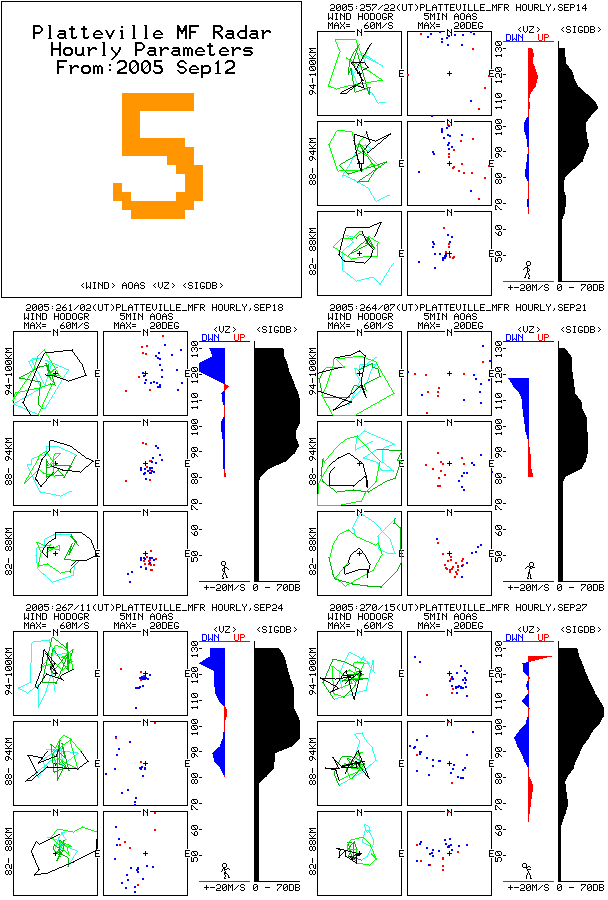
Please contact Chris or Alan if you wish to collaborate in any study using these data ( chris.meek@usask.ca; alan.manson@usask.ca)
Professor Alan Manson (Physics and Engineering Physics, Emeritus), Dr. Chris Meek (Research Associate, Emeritus), Dr. Zhenhua Li (CANDAC-PAHA PDF)
Our group studies the Dynamics of the Mesosphere, Stratosphere and Tropopause, or Middle Atmosphere (circa 10 - 100km) … below us is the obscure ‘boundary layer’ or biosphere, while 100 km is near the seasonally height-varying Turbopause. We avoid chaos! The observing instrument is mainly the “Medium Frequency Radar” (MFR, or MF 2.2Mhz at Saskatoon, 52N 107W ) which has operated continuously since 1979, or for 3.5 solar cycles, SC; the second MFR is located ( since 1987 and so 3 SC) at Tromso, Norway on the EISCAT site (70N, 19E). We have also operated MFRs at triangles of unique size: 40km using three receiving sites ( GRAVNET) near Saskatoon (circa 1988); a 500km-sided triangle, with two additional MF radars (Robsart, Sask., 49N 109W; Sylvan Lake, Alberta, 52N 114W), which were developed for the Canadian Network for Space Research (CNSR 1992-97); and another MF (forming a NS pair) located at Platteville (Colorado, 40N 105W) as part of the CEDAR program (2002-2015). The addition of international colleagues with an MF at London (1997-2005; Canada 43N, 81W), and two MFRs in Japan (Wakkanai, 45N, 142E; Yamagawa, 31N, 131E), along with our Platteville and Saskatoon MFRs, formed the CUJO Network (Canadian-USA-Japan Opportunity] 81W to 142E, years 2000-2007); and finally the ‘Scandinavian Triangle’ (sides 125 to 270km) with other colleagues for Andenes, (69N, 16E), Tromso (70N 19E) and Esrange (Meteor radar, 68N, 21E) for 1999-2008 . Despite the words thus far on “techniques”, we do not allow the radar technique to dominate our research interests, which have always been atmospheric: top of boundary layer (5km) to turbopause (circa 100km), coupling between regions of the planet, tropical to polar, southern and northern hemispheres. Data from the above triangles are archived and would be willingly provided to those with collaborative ideas-papers beyond ours
The development of CANDAC-PEARL at Eureka, Ellesmere Island (80N) www.candac.ca has more recently provided a VHF meteor-scatter radar for winds and temperatures; this SKiYMET system was purchased from MARDOC Inc. Prof Manson is a Co-I for CANDAC [member of the Scientific Steering Committee], and along with Dr Meek “mentors” of the Eureka radar. We provide data to the CANDAC-PEARL Archive for international scientific community-collaborations; time sequences of preliminary data are available for perusal elsewhere at this ISAS web site. Our data archive runs from mid-February 2006, (with gap Sept.2013 to Sept.2015) and continues to this time (May 17, 2017).
The MFRs provide echoes from 55/75 to 110 km during day/night hours, and are analyzed by ‘spaced- antenna’ and interferometric techniques to provide winds and wave characterization with periods from 10 min. to 10 years (solar cycle intervals). For SKiYMET, neutral winds data are available from 82-97km. Atmospheric waves involve gravity waves (GW, 10 min to 15 h), tides that are migrating and ‘non-migrating with the sun’ (6-, 8-, 12- and 24-h), planetary waves (PW) (2 - 30d) and seasonal oscillations (12-, 6-, and 3-mths). The minimum period GWs from SKiYMET are 2 hrs; 10 min from the MFR. The three radars provide unique information on the spectral characteristics and wavelengths of these waves; the temporal variability and climatologies of the tides, GW and PW; latitudinal and longitudinal variabilities, structures and modes; and the physical coupling mechanisms between these various scales of motion. Tidal observations have been very successful in providing comprehensive knowledge of the seasonal variations of the 12- and 24-h migrating tides: 65-100km. Tides within the best GCMs, e.g. CMAM, are in useful agreement, but observed tides from Eureka (80N) and Svalbard (78N) are larger than modeled…also, their variability, which is due to non-migrating tides and specifically to Planetary Waves interactions, is larger than modelled.
Our research at Saskatoon has been and is coordinated with national and global-projects of SCOSTEP: “Scientific Committee on Solar Terrestrial Physics”, which match the interests of ISAS very well [Physics and Engineering Physics Dept, University of Saskatchewan], 1957 to present (May, 2017). SCOSTEP provides international collaborative programs and campaigns: VarSITI 2014-18 [Variability of the Sun and Its Terrestrial Impact], with our theme of interest, ROSMIC [Role Of the Sun and the Middle atmosphere / thermosphere / ionosphere In Climate).
During CAWSES (Climate and Weather of Sun-Earth System), 2004-08, Alan Manson led the ’Polar Vortex’ theme within CAWSES. We continue studies of the variabilities of the Polar Vortex within the ‘Polar Night’ Theme of CANDAC-PAHA: ‘Probing the Atmosphere of the High Arctic’, 2014-18. www.candac.ca Earlier completed SCOSTEP programs, for which archived data are also available include: Middle Atmosphere Program (MAP: 1982-85); Solar-Terrestrial Energy Program (STEP: 1990-97); STEP-Results, Applications, and Modeling Phase (SRAMP: 1998-2002); PSMOS (2002-2004. Satellite data are used from a variety of Missions: UARS-WINDII, UARS-HRDI, TIMED-SABER, -TIDI, Odin-OSIRIS, Aura-MLS, ACE-FTS. We are engaged/collaborate with the strong theoretical/observational activity within SPARC (Stratosphere-troposphere Processes and their Role in Climate) and MLT (Mesosphere Lower Thermosphere) communities. These involve tidal and PW studies; time-dependent gravity wave-, tide-, mean wind-structures within GCMs, whose results are usually consistent: Canadian GCM (GEM); CMAM-DAS, with integrated chemistry and ‘data assimilation’, DA; CMAM-30; UKMO-DA [UK Met Office] (used mainly), GEOS-DAS-5-MERRA. The US-based CEDAR programme (‘Polar Workshop’ e.g. Neutral Dynamics, 2017) also provides a regional North American framework for Middle Atmosphere (circa 10 to 100 km) research.
The nature of our CANDAC-PEARL (2005-17+) research [see nearby in this site for thematic research and papers] was collaboratively linked with CAWSES (2004-2008) and related continuations within ROSMIC, especially with the area of ‘waves and coupling processes’ at Eureka. Collaborations with other high latitude radars are engaged/essential e.g. Svalbard, Norway. Briefly: The Polar Regions are unique in the dynamics of the terrestrial atmosphere as they are in the vicinity of the Earth’s rotational axis. In the middle atmosphere they are seasonally and globally the site of large scale ascent and descent, summer/winter in the Arctic/Antarctic. Through our studies and models, also SCOSTEP programs, the consensus of atmospheric science communities is that global dynamics are driven by wave-breaking and dissipation [GW and PW], are either dominant or essential to understanding, knowledge and improved prediction capabilities of operational forecasting GCMs. On this latter, the MSC-EEEC has modest interest in what we are doing…lack of $- support appears to be a problem. Further, various oscillations within oceans and atmosphere [ENSO, AO (NAO), PDO and NPM, PNA] within which waves are imbedded, are jointly involved in rich explanations of large scale coupling processes in the various regions of the atmosphere. The Polar Winter Vortex [PV] is a dominant system for Canadian weather and climate. The purpose of our PAHA-CCAR [“Probing the Atmosphere of the High Arctic” (2014-2018) [Canadian Climate and Atmospheric Research-NSERC]) studies is, for the polar middle atmosphere [circa 10-100km], to identify large scale motions and constituent changes, and to link wave phenomena to the Earth’s large scale circulation and to scales of Canadian provinces. The primary objectives include:
- Investigation of wave signatures (gravity waves, tides and planetary waves) in the polar region, especially during disturbed conditions.
- Identification and characterization of the processes which couple the polar region to other regions of the global atmosphere and also the various altitude regions (troposphere, stratosphere, mesosphere/lower thermosphere) with each other … also longitudinal and hemispheric entities, since symmetry is not assumed.
- Unique phenomena that occur as a result of this coupling and the wave-types themselves: ‘sudden mid-winter stratospheric warmings’, SSW; global constituent and aerosol mixing; extreme variability of wind and temperature-systems; disturbed non-climatological polar latitude airglow signatures [used by GB optical systems without height-ranging]; noctilucent clouds, and systematic and abnormal changes in cloud occurrences associated with Climate Change and Solar Activity.)
A focus upon the ‘radiationally unexpected’ phenomena in the atmosphere, circa 10 to 100 km (middle atmosphere, MA) continues to engage and stimulate us. They offer enormous observational advantages. These events are so unique that they require extreme combinations of dynamics, chemistry and radiation to bring them into existence: phenomena such as SSW (SUDDEN stratospheric warmings) that suggest instabilities; mesospheric inversion layers [MIL]; equinoctial transitions…‘Final Stratospheric Warmings’ (of spring) as compared with mid-winter warmings (and are they really ‘Sudden’?); Stratospheric Warmings in the Arctic and Antarctica, with implications for “Ozone Anomalies”, and the “Winter Anomaly” (of D-region ionization )…all await deeper understanding. As example, is not clear that the polar stratospheres of the annual ‘two polar nights’, are comprehensively understood. Why there? No UV radiation! Also, the SSW studies focus upon 10hPa or 30 km, while the maximum energy and minimization occurs at 50-55 km! We have engaged in global studies throughout our careers and continue this essential dynamic … collaborations with colleagues at lower and tropical locations are welcomed.
The hemispheric differences in all of these phenomena must be considered…we are fortunate to live on ‘two-planets’. The studies must also be inclusive of all latitudes of the planet earth, as the equatorial regions have strong effects upon such phenomena, directly or indirectly, through dynamical processes. Their possible influences of Climate Change upon processes must be strongly in our thinking and strategies.
Optional! Thoughts on Research in Academe, 2017: the group at Saskatoon includes an emeritus senior scientist and research associate (Prof Alan Manson, Dr. Chris Meek), with PDF as PAHA funding allows (Zhenhua Li has been with us for three years [Feb 2014-May 2017]). We now look after the cost, maintenance and operation of the Saskatoon radar ourselves, as ‘Discovery Grant’-funding [expected base-line $ for well-behaved and productive academics on Nationally- and University-approved themes] from NSERC for senior scientists, such as we, is often not awarded. It seems that professors approved by Universities at Emeritus level, who were performing well and above average, for significant career-durations, should be awarded some reasonable subsistence level for ‘a few years’ [publications, attendance at conferences]. E.g. $10-15K pa. Otherwise, prominent Canadians suddenly vanish from the International scene, never to be seen again! This at a time when some Canadian Research Chairs remark that they have too many $, and that the demands placed upon them by the ‘system’ are then beyond reasonable human expectations. I also remark, for the interest of those reading this paragraph, that typical Discovery Grants are now less than half what this modest man received annually for most of his career [unadjusted $]. Further, we seniors have trouble supervising the ‘essential graduate students’ [to some, the main role of Academic-research is as a Grad-MSc/PhD factory for national-wealth], as another younger Professor is required as co-supervisor-colleague.
There is more to ‘say’: The Description of ‘methodologies’ for natural science research, within the NSERC Discovery Grant document, is somewhat unique [developed politically over the last decade] and fixated upon goals and deliverables [we are not all Engineers who design and build beautiful and useful things]. Certainly, quite unlike excellent writings by Professors of Philosophy on the ‘scientific method’ [realistic to we scientists], this Description reads as if directed toward students in an undergraduate Physics or Engineering Lab. [maybe not a splendid lab], where success is almost assured, and goals sensibly never in doubt. Dramatic occurrences testify to this, from conversations with groups of mature ‘grad-students’: They, who were well mentored in the methodology and practices of research (by their supervisors) and who then explain their [now understood /appreciated] approaches and methods in Applications for NSERC Grad Schols, have received rejections and criticism based upon their proposed ‘methods’. (As has Manson, in the second rejection [of my entire career, 49 years] of a Discovery Grant Application in 2012 (after fixing the problems noted in 2011 [reviewing systems have no memory]). Upon reflection, and discussions with Uni-staff who ‘trouble-shoot such issues’, they later submitted grad-applications with the ‘methods provided or inherent in the NSERC application material’, and were generally very successful. They did not believe what they had written was GOOD, or correct, but they had to ‘play the game…the only game in town’. They realized their use of deception . Profs also may have Uni-advisors with skills in writing a successful application…further potential deceit. But, again, when the philosophy espoused in Discovery Grant literature is strongly evident in their applications, success rates are high. Members of committees have bought into this dogma, recognize it easily, award/’reward’ the writers, and have made ‘appeals’ close to impossible, based upon written materials in the Guide…even when aspects of that process may lack ethical stance/actions and even logic. Evidence of ‘innovation’ is also required, explicitly, as if it were not usually there for Profs who write excellent and numerous papers in “good” journals. Such demands lead to exceptional claims by some applicants, although there is no indication that actual deliverables are being later assessed by ‘the system’. It is with great relief that we note another word has been added to ‘Innovative’ in major headings surrounding the ‘Science Review’…the writer cannot find that excellent word…I think it was “Discovery”! Of course…
A commonly heard remark is that if Einstein were a junior Professor in Canada today, he would have trouble in being awarded a Discovery Grant…mathematical theoretical physics? Methodology…? Experience informs me, as Scientist/Professor and Academic/Research Administrator of 50yrs in Canada, that when an Admin-program such as NSERC’s Discovery Grant is so much out of tune with the needs of Professors across the nation, the designers of the system/program are not listening to, or talking with, the Professors in the front line of activity…and maybe there are not enough active Academic Professors involved in the design of the program. ‘Canada’s Fundamental Science Review’, April 10, 2017, contains much fine detail and wisdom…but really nothing of the above has been perceived, and therefore is not addressed. The contamination of the Grant Applications literature is clever, subtle, almost invisible, yet dogmatic and powerful…a strong philosophical cleanser is needed, urgently.
We appreciate the support, collaborations with Prof Chris Hall at Tromso [1987-present], who operates the MF radar there.
Fortunately, opportunities do exist [my pension] for us to interact and network with other scientists in Canada, through CANDAC-PEARL, and in the international SCOSTEP community. The ground-based systems and their associated research in Canada are well integrated with CSA-Space Science involving satellite prototypes /missions or data-archiving, so that opportunities for collaborations also exist.
We welcome contacts from Atmospheric Scientists who find our research, publications and data interesting. The dates and International Programs for which data are archived and available are provided above . We are likely to be interested in joining with you on topics of mutual interest.
Alan Manson
Phone: (306) 966-6449
Email: alan.manson@usask.ca
Websites: www.artsandscience.usask.ca/physics/isas
Chris Meek
Phone: (306) 966-6446
Email: chris.meek@usask.ca
Website: www.candac.ca
ISAS People
|
Billett, D. |
Associate Professor |
|
|
Bourassa, A.E. |
Professor |
|
|
Degenstein, D.A. |
Professor |
|
|
Hussey, G.C. |
Professor |
|
|
Koustov, A.V. |
Professor |
|
|
Llewellyn, E.J. |
Professor Emeritus |
|
|
Manson, A.H. |
Professor Emeritus |
|
|
Sofko, G.J. |
Professor Emeritus |
|
|
St-Maurice, J.P. |
Professor Emeritus |
|
|
Tegtmeier, S. |
Associate Professor |
|
|
Toohey, M. |
Associate Professor |
| McLinden, C. |
Adjunct Professor |
|
|
Sica, R. |
Adjunct Professor |
|
|
Contact Us
Institute of Space and Atmospheric Studies
University of Saskatchewan
116 Science Place - Room 260
Saskatoon, Saskatchewan
S7N 5E2
Canada
(306) 966-6445
(306) 966-6400
isas.office@usask.ca